Saturday, February 18, 2023


                                                             Ronald Reagan, No. 40

27 November 2022 / 15 January 2023

Dixon, IL / Washington, DC


Perhaps we can thank the town of Dixon, Illinois, for the fall of the Berlin Wall. And not just because it was where Ronald Reagan grew up.


In 1989, Dixon became a sister city to Dikson, in Siberia in the USSR. The relationship began that year as a result of a contact by a Russian journalist, according to the Dixon Sister Cities Association. A local journalist then responded, which led to the relationship between the two cities. It was formalized in Russia in May 1989 by Dikson Mayor Nikolai Kartamychev and Dixon Mayor James Dixon.


Russian Premier Mikhail Gorbachev reportedly said if the two cities could share peace, the countries could
, too. And the wall came down in November 1989.


Alas, Dixon didn’t get a piece of the Berlin Wall when pieces were handed out, but it does have a pretty terrific reproduction, which we discovered as we wandered around town on a cold, raw Thanksgiving weekend. Found in the “Wings of Peace and Freedom Park,” the reproduction comes complete with graffiti as well as a replica marker highlighting Reagan’s “tear down this wall” speech and a sculpture of a dove. The park also features three large murals illustrating the wall’s history, from President Kennedy’s time to its destruction. Above, a big peace sign, which lights up, hangs on the side of the city’s historic theater. The little park can be found at the corner of south Galena and E. 2nd streets.

Replica of the Berlin Wall


Reagan had a singular focus on defeating communism from the first day of his presidency, particularly Soviet communism.  He famously labeled Russia the “Evil Empire.”   Although he initially lifted President Carter’s grain embargo to incentivize better behavior, he thought the best way to thwart Russia was to build up U.S. defenses.  Over time U.S. defense spending was increased to about 7 percent of annual spending but in the USSR, it was estimated to be a whopping 25 percent of their budget (Morris, 1999).  


In 1983, Reagan started the Strategic Defense Initiative (SDI), a space-based defense system to shoot down Russian ballistic missiles.  The defense shield, once deployed, would consist of particle beams, chemical rockets, lasers, and x-rays.  It was quickly dubbed “Star Wars.”  [Tom worked on the environmental permitting for the SDI in the early 1990s, holed up in a sensitive compartmented information facility  (SCIFs) in a downtown Washington, DC “Beltway Bandit” office building.  The SDI program was unfunded in 1993.]


And of course, a major contributor to Reagan’s success in tearing apart the Eastern Block was the ascension of liberal Russian leader Mikhail Gorbachev.  Reagan felt that Gorbachev, unlike previous Soviet leaders, could be reasoned with.  


Reagan’s defense spending is credited for pushing the Russian economy into a tailspin and forcing  Gorbachev to institute perestroika (restructuring) and glasnost (openness).  Within a year of Reagan leaving office, Soviet empire would fold on itself and the Berlin Wall would be torn down.  Russian communism was dead after 72 brutal years.


The park was one of our last stops on our tour through Dixon. After driving into town and passing several “home of President Ronald Reagan” signs, we started our day at a cute diner called Flynnie’s. We ordered a very tasty breakfast: Cathy had waffles and sausage, while Tom ate scrambled eggs with sausage and hash browns. Cathy might have had something healthier, but Flynnie’s (on Depot Road, across from a grain elevator), stops serving oatmeal and yogurt parfaits at 11 a.m. on Saturdays. We showed up around noon (darn). National Waffle Day was also the following day, so Cathy thought it appropriate that she commemorate the day a bit early.


Inside Flynnie's Diner

We chatted with our waiter, the son of the owners, and asked him about Reagan. He told us that nobody in Dixon really thinks about the fact that Reagan grew up there. Our first thought was that Dixon was a far cry from Plains, Georgia, which basically worships Jimmy Carter, a valued and integral member of the community.


We showed our waiter a photo of Dixon in March 1981 with a huge crowd holding “Get well, Dutch” signs following the assassination attempt that month.  “That’s pretty cool,” he said, “I was born in 1983.”  “Your parent may have been in that crowd,” we told him.


And while perhaps the current locals don’t think about Reagan too often, it’s hard to miss his influence, as tributes dot the landscape throughout the city — which we were already discovering.


Those who remember Reagan recall a charming optimist who tried to see the good in people.  He was known for his sly sense of humor including the unforgettable comeback during the 1984 presidential debate when he was asked about his “advanced” age of 73 versus that of Democrat Walter Mondale’s 56.  He glibly replied, “I am not going to exploit, for political purposes, my opponent’s youth and inexperience.”  The audience roared.  Even Mondale laughed.  (Reagan’s detractors weren’t as kind and called him remote, guarded, overly trusting, not detail oriented and an intellectual lightweight.) 


We headed out on the raw, gray, 40-degree day. Thankfully, the rain — which had been coming down hard on the way west from Chicago — stopped as we ventured forth. 


Our first stop was the Ronald Reagan Boyhood Home, which is a bit of a misnomer. Reagan’s family moved in when he was 9, in 1920, and stayed until 1923 before moving on to another house in town. Reagan lived in various houses in Dixon until he was 21.


After attending Eureka College, Reagan became a local radio personality but had a desire to be in the movie industry.  A Hollywood friend connection got him a screen test.  His athletic build and good looks impressed and he landed a contract.  By the time he was 32 years old, he a was top box office draw; rating higher than James Cagney.  One of his best-known roles was as the dying George Gipp in Knute Rockne, All American.


Tom in front of Reagan's home
in Dixon, IL
The white, two-story house is on South Hennepin Street, fairly close to the business district. It has a nice, welcoming porch. Unfortunately, that’s all we could see of the house, which closed in October for the winter (It reopens in April). There’s also a visitor center next door, but that was closed, too. 


A statue of a standing, presidential Reagan is on the property outside the visitor center, with the placard sporting a typo (it’s instead of its) that has obviously been fixed up.


After looking through the windows of the house, we drove down to the riverfront, where we discovered a lovely walking path along the Rock River. 
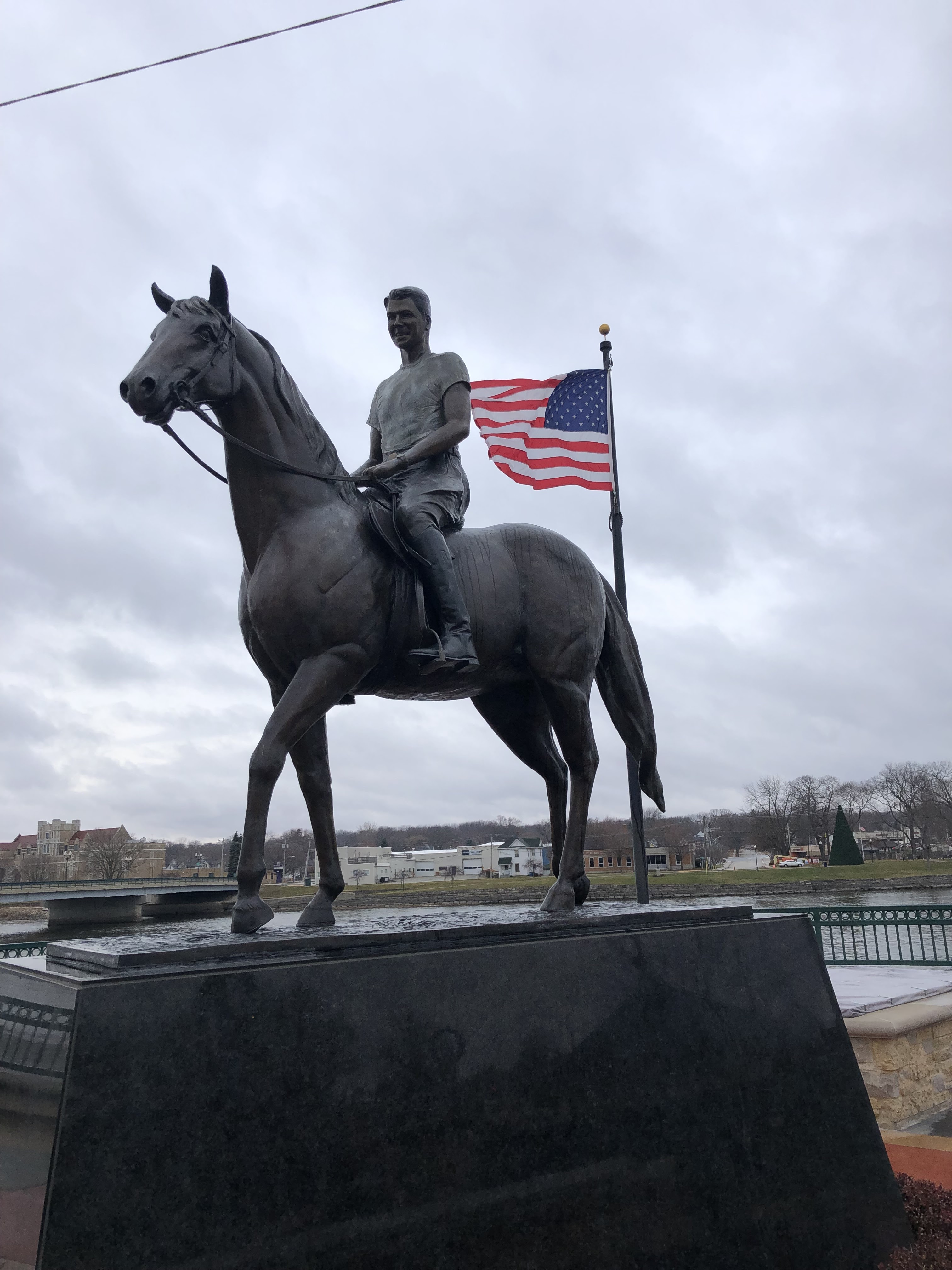
 

The returning
Hollywood star

There in the center of a plaza is another tribute to Reagan, a statue depicting him as a young man on horseback—evoking his celebratory ride leading a parade through the city when he visited in 1950 as a returning Hollywood star. 


By that time, Reagan had become a central figure in Hollywood and was elected as president of the Screen Actor’s Guild (SAG) in 1947, serving until 1952.  He even led a strike while SAG president.


We also found a tribute to the Illinois part of the Lincoln Highway, a gazebo featuring interpretive panels detailing the history of the Lincoln Highway as it passed through Dixon (a timely find since Cathy had recently finished reading Amor Towles’ “The Lincoln Highway”).


Next, we walked up the hill along Galena Avenue toward the Dixon Arch that welcomes visitors to town, since Tom wanted to take a picture of the arch from the same angle as the one shown in the book “Dutch.” 


That’s when we discovered the Berlin Wall reproduction.


Our last stop was Lowell Park, where Reagan famously spent summers as a lifeguard once he turned 16. Reagan spent seven summers there as a lifeguard, saving 77 swimmers from drowning. The park is on the Rock River, which had a strong current when we checked it out. Reagan often showed visitors to the Oval Office a picture of the river while telling them that lifeguarding was “one of the best jobs I ever had,” according to the official Dixon website. The park

Lifeguard Reagan at Lowell Park
is on the National Register of Historic Places.

 Reagan wasn’t always a conservative Republican.  In fact, he was a New Deal Democratic and supported FDR and the New Deal.  He campaigned for Harry Truman in 1948.  While in Hollywood Reagan actually tried to join the communist party but was turned down because he wasn’t viewed as fervent enough.  


Reagan eventually turned against communism and embraced more and more a conservative philosophy.  He registered as a Republican in 1962.   In 1966, he ran for governor of California as a Republican and defeated Governor Edmund Brown.  He was now governor of the world’s sixth largest economy.  He fought against programs that he thought rewarded not working.  In 1971, he signed the Welfare Reform Act resulting in stricter eligibility standards and compliance monitoring. Eventually 300,000 people were removed from welfare.  These successes had an effect across the country and Reagan became a national figure.


In 1976, Reagan shook up the Republican Party and challenged incumbent Gerald Ford for the Republican nomination.  Reagan didn’t respect that Ford was an unelected president.  During Ford’s presidency, Reagan had turned down offers to serve as Secretary of Transportation and Secretary of Commerce.  The nomination fight was bitter and Ford eked out a narrow win.  But he was damaged and a sitting duck for Jimmy Carter.  


Four years later, Reagan handily won the Republican nomination and the presidency.  The conservative revolution had begun.  Reagan famously said:  “Government is not the solution to our problems, government is the problem” (Morris, 1999).


Once president, Reagan pushed hard for tax and spending cuts. He embraced the philosophy of economist Arthur Laffer who argued that if tax rates were cut, people and corporations would have more incentive to work--increased tax revenues more than making up for the shortfall in rates.  Regan got his tax cuts but not the spending cuts (in fact, spending, led by defense, rose).  This caused the national debt to double to $1T.  Reagan’s approach was dubbed “Reagonomics.”  The country headed into a recession, mostly because the Federal Reserve raised interest rates to combat the 13+ percent inflation when Reagan took office.  Hard economic times are usually blamed on the president and Reagan’s popularity fell to 35 percent by 1982.  


An assassination attempt outside the Washington Hilton nearly brought his presidency and his life to an early close.  On March 30, 1981, Reagan was leaving the Washington Hilton after giving a speech to members of the AFL-CIO.  If was 2:25 p.m.  Six shots were fired in a scant two seconds.  Four of those bullets hit Reagan and his party.  The Secret Service shoved Reagan into a limo and raced to the George Washington University Hospital.  Nobody knew the extent of his injuries.  Once at the hospital, Reagan walked into the emergency room and then collapsed.  A fragment of one of the .22 caliber Devastator bullets had lodged within an inch of his heart.  He was losing blood fast and ultimately lost half of his supply.  But, of course, he survived—as did his humor.  At one point he quipped to his surgeons, “Please tell me you’re Republicans.” (Morris, 1999).  He also told his wife, “Honey, I forgot to duck.” (Morris, 1999).  In addition to Reagan, a Secret Service agent suffered a shot in his chest and a Washington policeman took a bullet in his spine.  The unluckiest was press secretary James Brady who was shot in the head and would never walk again.  (He spent the rest of his life advocating for gun control.)  Reagan walked out of the hospital on April 11.


Side door of the 
Washington Hilton:
site of the 1981
assassination attempt.

In January, we drove to the site, the side door of the Hilton. We had been through that door many times to register for the annual Washington DC Triathlon or to attend an occasional White House Correspondents’ Dinner. but had never lingered to contemplate the historic significance.  On this night, it was full of cars, hotel guests and valets.  We couldn’t stay long and had to back out of the scrum.  


Reagan’s foray into the Middle East was less successful than his handling of the USSR.  In 1983, he sent troops to Lebanon as part of a multi-national force to help quell the civil war rocking the country.  In April 1983, a truck bomb struck the American embassy killing 17 Americans and scores of Lebanese.  An even worse calamity struck in October the same year when another truck bomb decimated the Marine barracks at Beirut airport and killed 241 marines.  By 1984, there were no more American troops in Lebanon.


Still, Reagan was easily elected in 1984, beating Walter Mondale in every state except Mondale’s home state of Minnesota.


His second term was more troubled than his first.  In May 1985, he visited Europe to commemorate the 40th anniversary of the end of World War II in Europe.  As part of that visit, he made an ill-advised side trip to the Bitburg Cemetery knowing there were former SS officers buried there.  He said, “Those young men are victims of Nazism also, even though they were fighting in the German uniform, drafted into service…They were victims, just as surely as the victims in the concentration camp” (Morris, 1999).  Margaret Thatcher, usually a strong Reagan ally said that his visit was “deeply offensive and insulting to the memory of the victims…to all who fought in the last war to destroy the Nazi tyranny” (Morris, 1999). 


He attempted to even out the faux pas by also visiting the Bergen-Belsen concentration camp the following day.  This was where Anne Frank perished.  [It was also where Tom’s Jewish Hungarian great aunt Ibi was incarcerated toward the end of the war.  Fortunately, she survived. She later told Tom that when they were freed, they were nothing but csont emberek (bone people).]


Further diminishing Reagan’s legacy was the complicated Iran/Contra scandal. Through Israel, the United States sold 2,000+ TOW antitank missiles and 18 Hawk helicopters to Iran in support of their  war against Iraq.  As a direct result, Iran facilitated the release of seven U.S. hostages.  This sale violated the Arms Export Control Act since it should have been reported to Congress.  To make matters worse, some of the money was funneled through Swiss bank accounts to Nicaragua to support a group of so called “contras” fighting the Sandinista government. That action violated the Boland Amendment which stipulated no secret funding of the contras.  Reagan to his credit was out of the loop but his staff were implicated.  Colonel Oliver North headed up the operations and was convicted for his role. (North served no prison time and his conviction was vacated in 1991.) Reagan’s approval rating fell to 46 percent.


***


Reagan’s legacy is the emergence of the modern conservative movement and the defeat of the Soviet Union.  


Always in love
(Source: Vogue.com)

It's impossible to write about Reagan without mentioning his wife Nancy.  Their 52 year marriage was a love story.  Reagan’s Hollywood nine-year marriage to Jane Wyman had ended in divorce and in Reagan’s words, “along came Nancy Davis and saved my soul.” (Morris, 1999).  They were married March 4, 1952.  Reagan would write love letters to Nancy that included lines such as “…just waking up becomes a warm glow because you are there….” (Morris, 1999).  She was his soulmate and confidante.  She was a good judge of people and helped Reagan build and pare his presidential staff.  If she sensed that someone wasn’t performing, she would find ways to get rid of them.  


DIRECTIONS


Dixon is located on State Highway 52, just under two hours from Chicago.


REFERENCES


Rubenstein, David.  2019.  The American Story:  Conversations with Master Historians.  H.W. Brands on Ronald Reagan.  Simon & Schuster.  New York, NY. 


Morris, Edmund.  1999.  Dutch:  A Memoir of Ronald Reagan.  Random House.  New York, NY.  


Videos


History Channel.  2005.  The Presidents:  The Lives and Legacies of the 43 Leaders of the United States.


Monday, November 21, 2022


Jimmy Carter, No. 39

October 1 & 2, 2022

Plains, GA


Jimmy and Rosalynn Carter
The tiny community of Plains, Georgia, is known for one thing — it is the home of Jimmy Carter.


The town, population 758 and home to the Jimmy Carter National Historical Park, plays up that history and connection. The historical park is made up of several sites important in Carter’s life — all with free admission: His boyhood farm, his current home, his school, the railroad depot — home to his 1976 campaign — and brother Billy’s gas station. The one-block “business district” boasts a giant sign on the building that says “Plains, Georgia. Home of Jimmy Carter. Our 39th president.”


As Carter was famously known as a peanut farmer, wooden cutout peanuts dot the downtown — as did “Happy 98th Birthday” yard signs on the day we visited: Oct. 1, the birthday of America’s oldest living president.


Carter didn’t actually grow up in Plains. No, his family’s farm was 2.5 miles away in the now-defunct community of Archery. And that is where we headed after we landed at the Atlanta airport.


A 2 1/2 -hour drive later, we arrived at the farm in mid- to late afternoon. Hurricane Ian was spreading destruction in Florida and the Eastern coast of the United States, but we were far enough inland to be spared and rewarded with a brilliant blue sky and 80-degree temperature—a treat for October.


We were not alone. It was Carter’s birthday, so we shouldn’t have been surprised to see a lot of cars, several tour buses and a couple of shuttle buses. Outdoor tents were set up with dozens of folding chairs, obviously for some sort of presentation or lecture. And the National Park Service had set up tables with games and puzzles related to Carter’s presidency.


Turns out, the niceties were for a group of donors from the Carter Center, the Atlanta nonprofit Jimmy and Rosalynn Carter set up to focus on humanitarian causes and the importance of democratic elections after he left the presidency. Fortunately, their festivities were ending as we arrived. The group left to do a drive by of the Carter Compound, where the Carters were enjoying his birthday behind the property’s Secret Service-protected gates. Also in town were former staffers with the White House Communications Agency, who had planned a weekend reunion in Plains. (More on that later).


Carter boyhood home

Carter’s boyhood home — the family moved there in 1924, when Jimmy was 4 — is an unassuming, one-level bungalow on the family farm. The house has both a front and back porch, and there are several spacious rooms on each side of the center hallway. Billy, who was 13 years younger, took over Jimmy’s room when Jimmy — who was the oldest of Earl and Lillian Carter’s children — went to the U.S. Naval Academy.


The windmill

At first, the family had to use an outhouse. But in 1935, Earl Carter bought a windmill from a mail-order catalog, and built it with piping to provide running water for the kitchen and bathroom with shower and toilet. The shower head is actually a bucket with holes in the bottom, and the water was cold. But still, the family found the cold water superior to the no indoor water. The Carter family also installed electricity in 1938. 


Each room in the bungalow is filled with books. Lillian Carter instilled a love of reading in her children, and in fact, encouraged them to read—rather than talk—at the breakfast table.


The farm was 360 acres, and Earl Carter grew cotton, corn, peanuts and sugar cane on the land in addition to the family garden and pecan trees. Earl sold it in 1949, with the National Park Service later buying 17 acres back in 1994 to establish the historic site.


The family had 20-30 mules and horses to work the crops, plus cows. Of all their chores, the Carter children hated cleaning the cotton the most.


The family also had pecan trees. The kids and Lillian would collect the pecans from the trees, walk down the railroad tracks to town and sell their pecans — “free money,” Lillian said.


The farm, which looks to have been self-sufficient, has more than a half-dozen buildings, including Earl Carter’s commissary/store, barns, a blacksmith building, pumping shed and tenant houses. It also has a grass tennis court and a reproduction of the windmill. Jimmy Carter voices the audio recordings in the various buildings, explaining life on the farm.


In one recording, Carter says that the proudest moment in his young life was when he and a mule were finally able to plow the land.


The Carter's general store

The store in particular is quite impressive. It sold just about everything a farmer or tenant could need: sugar, flour, tobacco, food, lard, fatback, salmon, sardines, candy, clothes (gloves, overalls, shoes), medicine, soap, and matches, to name some of the items. It even has a gas pump.


Workers paid on credit, with the money coming out of their paychecks on payday. Unfortunately, that meant that the workers were almost always indebted to the Carters.


Currently, the farm has some chickens, five goats, a bunch of crops, and a scarecrow.


Jack & Rachel Clark

Carter also shares in a recording that the black sharecropper couple that lived on the farm, Jack and Rachel Clark, were huge influences in his life, right behind his parents. Carter would stay with the Clarks when his parents were out of town.


The Clark’s house is not that small, but it does show the inferior construction as compared with the Carter home. There are holes between the floor boards, and newspapers hang on the walls as insulation. 


Archery no longer exists.  We asked a young volunteer what had happened to everyone.  He said Archery “had dried out.”  We could only ponder what that meant.


Having thoroughly toured the farm, we headed out. But we arrived at the high school/visitors center about five minutes before closing time, so we decided to return the next day and headed to the Carter Compound, as it is called, about a one-minute drive up the street.


Carter compound guarded
by the Secret Service

There is a public viewpoint on Main Street, technically on the Carters’ property.  The Carter’s house is behind a Secret Service-guarded gate. You can’t see the house, though you can see some other buildings as well as part of the pond where Carter likes to fish. The beginning of Rosalynn Carter’s butterfly garden trail begins here, as well.  We felt the eyes of the unseen Secret Service agents on us as we stared at the compound.


The Carters’ house was built in 1961 and has undergone several renovations. The property includes a pool, pond, jogging path, a guest house above Carter’s woodworking studio, and several other buildings.


In this house, Carter wrote his inaugural address and other important speeches, interviewed candidates for vice president and Cabinet positions, and met with foreign dignitaries. The house also houses a lot of memorabilia from the White House, a National Park Service guide told us.


Afterward, we headed out of town on country roads to spend the night at the Lake Blackshear Resort inside the Georgia Veterans State Park, about 45 minutes south.


Lake Blackshear


Lake Blackshear is in Cordell, Georgia. Don’t let the word “resort” fool you. It was a lovely space, with lots of things to do, but it wasn’t ostentatious. 


Soon after we arrived, we enjoyed a sunset swim in the lake. Our swim was a mere 20 minutes, though — the

Swimming in Lake
Blackshear

water was cold, the sun was setting and we were concerned that the many alligators reportedly living in the area hadn’t gotten the memo that they dislike beaches and cold water, and would come to taste us. There are “Gator Country,” warning signs throughout the resort and state park.


After settling in, we had dinner at Cordelia’s restaurant at the resort. Cathy had shrimp and grits, being as we were in the south, while Tom had cioppino. For dessert, we had a delicious peach bread pudding crumble with vanilla ice cream. Yum!


The next morning, Cathy went for a run around the state park (both on trails and street) while Tom explored. The park features a bomber and three smaller planes, plus about a dozen tanks on display outdoors. 


Afterward, we rented kayaks for an hour and explored the beautiful cypress swamps and checked out the wildlife. This is more likely where the gators would hang out, but we didn’t see any.  Again, the weather was too cold for them to be active — but Cathy wasn’t taking any chances. She didn’t get too close to cypress, and stayed far away from the turtles on the log we saw (perfect snacks for any gators in the area).


Then we headed back north to Plains, after lunch at the resort’s Cypress Grill on the lake. 


Visiting Plains and the rest of the historic site


We went directly to the Plains K-12 school, where the White House Communications Agency veterans were staging their reunion in the couple-hundred-seat auditorium.


The agency is a military branch that is in charge of all the secure communications at the White House — switchboards, communications on trips, internet, etc. The group started doing informal reunions several years ago at the hometowns of various presidents. Typically, a couple dozen people show up. But for the reunion in Plains, a couple hundred people came for the three-day gathering, several of the former staffers told us. We chatted with some of them.  We were told that the WHCA is a semi-secret, 80-year-old military agency. It is part of the White House Military Office.  Apparently, you can’t apply to the Agency, but are hand picked after much vetting.  Cool cloak and dagger stuff.


One of the former staffers we met was Ron Peterson, who started working the White House switchboard in 1980 and told us about meeting President Carter during his first week on the job. He passed Carter as the president walked from the Old Executive Office Building (EOB) to the West Wing. They said “good morning” to each other. The agency was in charge of keeping track of Carter at all times. So he told his supervisor Carter was in the West Wing. His supervisor said no, he’s in the EOB. Mr. Peterson said no, I just passed him. Then a marine called to report that he had indeed arrived in the West Wing.  It was an event young Peterson never forgot.


The school has been converted to a visitor’s center, with three adjoining rooms displaying information about Carter’s presidency and post-presidency. One room is set up as a schoolroom so visitors can see what school was like for Carter and his fellow students. There also are displays throughout discussing segregation and what that was like for the youth of Plains. Another room is a gift shop (of course).


The center is not chock full of historical information, like the Ford Museum was — you need to go to the Jimmy Carter Presidential Library and Museum in Atlanta for that. But it did have some interesting history and some videos

Carter's high school, now a museum

.


Carter established two Cabinet departments: Energy in 1977 and Education in 1979. He also appointed the first Black female Cabinet member — Patricia Harris, who ran the Department of Housing and Urban Development.


Carter, a nuclear power expert when he was with the Navy, had been long concerned about the environment and put 32 solar panels on the White House roof.


There are many photographs of Rosalynn Carter.  Jimmy and Rosalynn knew each other all their lives. The day after their first date, Jimmy told his mother he was going to marry her.  They married a year later on July 7, 1946.  She was 18 and he was 21.  They’ve now been married for 76 years!


Rosalynn was very involved in the presidency, almost shockingly so. Perhaps it was because Carter had learned his lesson after deciding to return from California to Plains when his father died—without consulting her. He also didn’t tell her he was running for the Georgia State Senate. Her wrath was considerable and after that he consulted with her on everything.  During his presidency, she attended Cabinet meetings, held weekly lunches with Carter to discuss policy, was her husband’s representative with world leaders, met with Cabinet officials by herself, reviewed legislation and lobbied Congress. 


The school/visitors center also houses videos and displays about his foreign policy accomplishments, particularly the Middle East peace talks at Camp David


The year was 1978 and Carter was able to convince the leaders of Egypt (Anwar Sadat) and Israel (Menachem Begin) to meet at Camp David, MD.  The two leaders were so antagonistic toward each other that Carter had to meet with each leader separately and slowly negotiate the terms of a peace treaty.  But within13 days, everyone had agreed to a framework for peace and signed the “Camp David Accords.”  On March 26, 1979, the famous three-way handshake and signing of the Egyptian-Israeli Peace Treaty took place at the White House.  It is Carter’s signal achievement.  The display includes a picture of Anwar Sadat touring Carter’s woodworking studio with him.


That was the high-water mark of his presidency.  It was all downhill from there:  boycotting the Moscow 1980 Olympics in response to Russia’s invasion of Afghanistan, 13% inflation, energy shortages, relinquishing ownership of the Panama Canal.  


All of that was co-mingled with events in Iran.  Ah, Iran.  


In a remarkably bad piece of judgment, Carter said that “Iran, because of the great leadership of the Shah, is an island of stability in one of the more troubled areas of the world” (Zelizer, 2010).  In October of 1979, Carter allowed the Shah to come to the United States for medical treatment, creating a power vacuum in Iran which was quickly filled by the followers of the formerly exiled Ayatollah Khomeini.  The Shah arrived in the U.S. on Oct. 23, 1979 and a few days later, Iranian students stormed the American embassy and took more than 50 diplomats hostage.  The “Iranian Hostage Crisis” would grind on for the rest of his presidency. Carter authorized a rescue mission in 1980 that only resulted in a pile of broken machinery and eight dead soldiers in the Iranian desert. 


Carter, who had had an approval rating of 75% earlier in his presidency was now below 30 percent.  His presidency had started on such hope after Ford’s caretaker presidency.  On inauguration day, he, Rosalynn and nine-year-old daughter Amy got out of the presidential limo and walked hand-in-hand down Pennsylvania Avenue to the White House.  


His presidency fizzled out and he never really stood a chance against Republican Ronald Reagan who won 489 electoral votes. Carter won only 49 electoral votes and won only Georgia in the South.  


One room was dedicated to the Carter Center, Carter’s signature post-presidency project.  Its mission is to prevent and resolve conflicts, enhance freedom and democracy, and improve health (cartercenter.org).  As laudable as the Center’s mission has been, there is a controversial event that may (or may not) have taken place in 2013.  Tom’s 91-year-old mother, who follows our travels and participated in our last visit to the Gerald Ford Museum, told us that she detests Carter because he had praised the 2013 Venezuelan election.  This would be surprising since Carter was a stickler for clean elections.  In 1989, Carter denounced Panama’s election that was being manipulated by strongman leader President Manuel Noriega.  Carter also helped set up the 1990 Nicaraguan national election at the invitation of Marxist President Daniel Ortega.  With Carter’s system and with the Carter Center monitoring the election, Ortega lost to Violeta Chamorro.  


So back to the Venezuelan election.  A web search revealed a May 2013 story in Foreign Policy titled “Jimmy Carter gets it wrong on Venezuela, again.”  The article states that Carter said that the election was "the best in the world."  However, we could find no other references to that statement on the internet.  We read the Carter Center’s report on monitoring the 2013 Venezuelan election but nowhere does it say anything about it being the “best in the world.”  It does say that the automated voting machines worked but that there was no way to verify access to voting machines or to prevent multiple voting by individuals.  The rest of the report noted gross inequities in access to media for non-state candidates as well as a lack of political observers in election audits.  The report offered ten recommendations for better elections.  


While at the farm, Tom asked a Carter Center staffer about Carter’s statement.  She said that it “sounds like something he would say” sarcastically but he would have qualified it with all the reasons it was not.  Was he quoted out of context?  This is yet a mystery—at least to us.


Afterward, we toured the tiny town of Plains. And we mean tiny.  


It is basically on one barely used two-lane road, aptly named Main Street, with a long building of storefronts, a grain silo, several churches and some other businesses.  On Sunday afternoon, although most of the bedraggled stores were open, nobody was moving around on the sidewalk.  There were only a handful of cars (including ours) parked on Main Street.


We popped in at Billy Carter’s Service Station, whose 1970s look has been preserved, right down to an old Coca-Cola machine and 1970s gas pumps. There also is a placard discussing the importance of the station historically: The media covering Carter’s campaign turned it into their headquarters. 


1976 Presidential headquarters

The railroad depot, almost across the street, was the home of Carter’s 1976 campaign. It was chosen for one simple reason: It was the only public building in town that had a bathroom. It is tiny, basically one room and the bathroom. Trains don’t stop at the station any more. Next to the depot on Main Street as well as the butterfly garden path is a lovely headstone for “the Depot dog: “J-Who’ 1976-86.” The garden path is a beautiful assortment of flowers and plants, all luring bees and butterflies on this warm day. The garden includes benches and even a swinging loveseat to enjoy.


Downtown Plains

Since it was a Sunday, many of the town’s stores were closed or had closed early. We finished our trip with a visit to the still open Plains Peanut Store.  A young woman named Tonya served us some peanut butter soft serve ice cream, swirled with chocolate. Delicious! Tonya told us she moved to Georgia from Queens, NY because her sister had a crush on Dominque Wilkens of the Atlanta Hawks professional basketball team.  And now she is in Plains and loving it. She said the cost of living can’t be beat.  Indeed, our soft serve was only $2.50.  


Brenda, the store owner—as well as many people around town—said the Carters are gracious and humble and “down to earth.” While we didn’t get to see them, even though we were so close, we did learn that the Carters had come into town Thursday night for dinner. One Park Service guide said that while he is now frail and in a wheelchair, his mind is still sharp and “you had better know your stuff” when talking with him.


We’ll end our journey by sharing a little story of how Carter and Gerald Ford became friends after the conclusion of their presidencies. They began their friendship as they travelled to Egypt in 1981 for the funeral of Anwar Sadat who had been gunned down by extremists because of the made peace he had made with Israel.  Carter and Ford agreed to help each other raise funds for their presidential libraries.  Over time they worked on many projects together.  They became so close that Ford asked Carter to give the eulogy at his funeral, which Carter did.  It’s a great example of how great men can put politics behind them and work together for the good of the country.


Directions


Plains, GA is located on U.S. 280 West about 2.5 hours south of Atlanta airport.


References


Cardenas, Jose R.  2013.  Jimmy Carter gets it wrong on Venezuela, again.  Foreign Policy, May 7, 2013.


Carter, Jimmy.  2015.  A Full Life, A: Reflections at Ninety.  Simon & Schuster.  New York, NY.


DeFrank, Thomas.  2007.  Write it When I’m Gone.  Berkley Books.  New York, NY.


Rubenstein, David.  2019.  The American Story:  Conversations with Master Historians.  Bob Woodward on Richard M. Nixon  Simon & Schuster.  New York, NY. 


Study Mission of The Carter Center 2013 Presidential Elections in Venezuela, Final Report.  April 14, 2013.  Cartercenter.org


Sullivan, Kevin and Jordan, Mary.  2021.  The Carter’s Record-Setting Love Story.  The Washington Post, July 6, 2021.


Zelizer, Julian.  2010.  Jimmy Carter.  Times Books.  Henry Holt and Company.  New York, NY. 

Saturday, June 11, 2022

Gerard R. Ford - No. 38 - Grand Rapids, MI - April 9, 2022


Gerald R. Ford

What is the best thing Gerald Ford did as president?

Why, build a pool at the White House, of course.


As avid swimmers, we were thrilled to learn that Ford was the president who installed the outdoor pool on the White House grounds. And he didn’t build it for his kids or to float on his back. He was a lifelong, dedicated swimmer who did laps every day, sometimes even twice a day in his retirement years. He quipped, “Fifteen minutes in the pool are worth two martinis” (DeFrank, 2007).


In fact, on his first day as president, the first thing he did in the morning was take a swim before heading to the White House.


In 1975, the pool, along with a cabana and showers, joined the list of amenities that first families have added to the White House. The outdoor pool, which joined the indoor pool built when FDR was in office, was the only change Ford made to the White House.


We learned about Ford’s love of swimming at the Gerald R. Ford Museum at the beginning of April 2022. It was a cold, gray, wet, raw day - with snow in the morning, despite the calendar saying it was April. A good day to spend inside a museum.  Tom’s 90-year-old mother, Marianne, who lives in nearby Kalamazoo, joined us.  (When we started our presidential journey 12 years ago, we had envisioned reaching Gerald Ford far earlier and having Tom’s father, Robert, join us.  Sadly, we lost Robert last summer.)


Gerald Ford Museum in Grand Rapids, MI.


The museum, which lies along the Grand River in Grand Rapids, Mich., is sleek and modern looking. It features a lot of open space, and it offers visitors many short films and interactive videos to learn from. It covers his entire life — from displays about his abusive father and loving stepfather to his Eagle Scout career (the only president to be an Eagle Scout), his political career and finally, his funeral. 


One display focuses on his love of sports. Growing up, he played basketball, track and, of course, was on the high school swim team (in the photo of his team, he towers above his teammates). His real love, though, was football, and the museum includes information about his attempted recruitment to the NFL by the Green Bay Packers — by Curly Lambeau himself(!) — and the Detroit Lions. While flattered, Ford opted to go to Yale Law School.


Ford's swimming days -
He is in the front row far left.

His stepfather was a big believer in sports, saying that sports “taught you how to live, how to compete but always by the rules, how to be part of a team, how to win, how to lose, and how to come back to try again.”


Another interesting fact highlighted in the display about Ford’s teenage years: In high school, he had a choice to go to a new high school, considered elite, or to South High, populated by children of immigrants. A family friend and his basketball coach told his parents to send him to South High, where “he will learn more about living.” And he did.


Of course, the museum is focused on Ford’s legacy as a congressman, vice president and president.  When he entered Congress in 1948, he was advised to either be a “parliamentarian” or get on important committees and become an expert.  So, he worked his way onto the Public Works Committee and the Appropriations Committee.  He spent 25 years in Congress, reaching House minority leader in 1964.  In October 1973, Nixon chose him as vice president to replace Spiro Agnew, who was caught up in a bribery and tax fraud scandal.  


Ford married Betty Bloomer, a ballerina and model in 1948.  When he proposed to her earlier that year, he told her, “I’d like to marry you, but we can’t get married until next fall and I can’t tell you why” (Thomas, 1999)  He had not yet announced he was running for Congress.


And while we kid (sort of) about the pool being the most important thing Ford accomplished as president, many — including George H.W. Bush — would argue that Ford’s presidency was critical to the nation because he “restored the integrity of the Oval Office.”


After taking office after the Watergate scandal, Ford said:  “My fellow Americans, our long national nightmare is over.  Our Constitution works; our great Republic is a government of laws and not of men….”


Ford was a modest president, eschewing the trappings of power.  He insisted that the Marine Band play the University of Michigan fight song instead of Hail to the Chief when he walked into rooms.


Ford signed the Helsinki Accords with the Soviet Union in 1975.  The agreement helped improve relations between the United States and the USSR and made travel to Eastern Europe easier.  For Tom’s family, it meant his parents could travel to their birth country Hungary with less fear of arrest for leaving the country ‘illegally’ in 1957.  Ford said later that the Helsinki Accords led to the downfall of the Soviet Union because of the human rights provisions in it.


Asked for her recollection of Ford, Tom’s mother replied, “I remember him coming down from an airplane and almost fell, and then people made fun of him.”  It’s true. Despite his athleticism, he had a reputation for clumsiness – as immortalized by Chevy Chase in Saturday Night Live.


Ford was subject to not one, but two, assassination attempts, both in the same month!  First, a Charlie Manson follower named Squeaky Fromme took a point-blank shot at Ford in Sacramento, CA.  Luckily, there was no round in the firing chamber of the loaded revolver.  Later that month of September 1975,  Sarah Jane Moore took two shots at Ford in San Francisco and missed him both times.


In addition to pardoning Nixon, Ford gave amnesty to Vietnam war draft dodgers.  He also pushed for admittance of 120,000 Vietnamese immigrants when South Vietnam fell in April 1975.


The economy was in the dumps.


During most of his time in the White House, the economy was in the dumps.  There is a line graph at the museum that shows inflation and the unemployment rate during his presidency.  In August 1974, inflation was running at 10.9% and the unemployment rate was 5.5%.  Inflation would rise to 12.4% by the end of that year and by mid-1975, unemployment was at 8.6%.  


Between the economy and the Nixon pardon, Ford’s run for a full four-year term in 1976 was doomed.  Another faux pas:  he dumped his Vice President Nelson Rockefeller for Kansas Senator Bob Dole.  (He never forgave himself for being disloyal to Rockefeller.)  


Conservative California Gov. Ronald Reagan sensed vulnerability in Ford and challenged him for the Republican nomination.  He almost won, too.  Ford held on by only 117 delegates out of 2,300.  In the general election, Ford lost to Georgia Gov, Jimmy Carter 297 to 240.  It didn’t help matters that Ford proclaimed in his second debate with Carter that “There is no Soviet domination in Eastern Europe, and there will never be under a Ford administration.”  Whoops.  


But Ford always believed he could have beaten Carter if Reagan hadn’t weakened him.  He said later, ““I deserved an opportunity to run…” (DeFrank, 2007).  Reagan’s success as a politician always bothered Ford.  He “considered Reagan a superficial, disengaged, intellectually lazy showman who didn’t do his homework and clung to a naïve, unrealistic, and essentially dangerous worldview.” (Defrank, 2007)


In retirement, Ford continued to crave his swimming.  At age 90, he still swam twice a day.  When he was sick at age 92, he complained, “My damn doctors won’t let me go in the pool.”  (DeFrank, 2007 ). 


Tom and his mother, Marianne
outside the museum.

Ford died in 2006 at the age of 93.  He and his wife, Betty, are buried just outside the museum.  We walked along a path to pay our respects.  Ford was the right president at the right time—honest, hardworking, and self-effacing.  He used to quip, “I’m a Ford, not a Lincoln.”  


Directions


The Gerald R. Ford Museum is located just off Highway 131 in downtown Grand Rapids.


References


DeFrank, Thomas.  2007.  Write it When I’m Gone.  Berkley Books.  New York, NY.


Thomas, Helen.  1999.  Front Row at the White House;  My Life and Times. Scribner.  New York, NY.