Sunday, October 31, 2010

John Adams - Boston and Quincy, MA

President No. 2 (1797-1801)
Boston – October 30, 2010
“We can’t go to all houses. Houses are boring. Do you really want to go to 43 houses?” Cathy said as we flew to Boston to learn about president number two, John Adams.

We were debating where to go to learn the most about John Adams. The John Adams Peacefield estate in nearby Quincy would certainly yield good information. But Cathy was right; did we really want to visit nothing but homes? We decided that walking the streets of Adams’ beloved Boston also could tell us much about him. So we decided to visit the Freedom Trail, a two-mile walk through historical Boston that stops at all of the major Boston Revolutionary War sites.

Travel note: We landed at Logan Airport on a crisp autumn day. We took the above ground T bus (silver line) to downtown Boston then switched to the underground rail. We later learned that it is quicker and easier to take the shuttle bus to the Airport T station (blue line), then zip into town. All rides on the T cost $2, no matter where you’re going.

Freedom Trail
Boston Masacre /
Crispus Attucks Monument
“The Idiot’s Guide to Boston: Follow the red line,” Cathy said. The Freedom Trail is indeed a thick red line painted on the sidewalk. In some areas it is represented by bricks. There is no real way to get lost. The trail starts in Boston Commons, an enormous grassy park so-named because it used to be a pasture where the commoners grazed their cattle and other farm animals.

On the Commons is a monument to the five colonists killed in the Boston Massacre. We’ll say more about that later, but it is worth noting that the monument contains an inscription from John Adams that reads “On that night the foundation of American Independence was laid.”

Dachshund in Full Gear
(Note: The following has nothing to do with John Adams. As we started up the Freedom Trail to Beacon Hill and the State House, we noticed a crowd. As we approached we saw dozens of wiener dogs scampering about, yelping. We had stumbled upon the monthly “Dachshund Meet-Up.” Since this was Halloween weekend, the dogs were in costume. My favorite was the hot dog costume, although the eventual winner of the costume contest was the ice cream sundae dog.)


Granary Burial Ground
Boston is full of old graveyards, perfect for a Halloween weekend. The Granary Burial Ground, a major cemetery, houses the graves of three Revolutionary War patriots — John’s cousin, Samuel Adams; John Hancock; and Paul Revere. (John Adams is buried in nearby Quincy, his birthplace and retirement home, with wife Abigail.) Also buried here are the remains of the five colonists killed during the Boston Massacre and Robert Treat Paine, one of the prosecuting attorneys against the British soldiers accused of murder during the massacre. Again, more on this later.

Although well maintained, the old gravestones are discolored and many are sinking into the earth. Many of the gravestones had been moved over time and they don’t necessarily reside over the grave referenced.

The Old State House and the Boston MassacreWe decided to the tour the Old State House for two reasons. First, it is a major historical site. Second, it was warm. (We had layered up, but found the 50-degree temperatures and the wind a cold combination).

This brings us to another travel aside: There are plenty of Starbucks and Dunkin’ Donuts lining the Freedom Trail, so staying warm with coffee or hot chocolate is not a problem.

For a $6 entrance fee, we had two guided tours — an indoor tour and an outdoor lecture on the Boston Massacre.

It was here in 1761 that James Otis railed against the Writs of Assistance — the British Army’s “illegal” searches of homes and businesses without cause and without warrant. John Adams attended the speech and it inspired him.

A bit of background is in order. Prior to the mid 1700s, the colonies had enjoyed 150 years of relative freedom from extensive British interference. In the mid-1700s the British Empire was in debt from the Seven Years’ War and needed additional revenue from the colonies. They imposed taxes on the colonists, the most notorious being the so-called Stamp Act. The colonists naturally were not eager to see their taxes increased, and resisted — the Massachusetts Bay Colony being one of the most resistant. The British sent over 4,000 troops to quell the 16,000 Bostonians, an astounding ratio of four to one.

Now, during our outdoor lecture about the Boston Massacre, we learned that basically what you were taught about the incident in third grade was propaganda for the colonists. The famous engraving of the incident that Paul Revere made and was distributed to the other colonies — showing British soldiers firing on unarmed, rich colonists — was also propaganda.

Instead, a large, angry mob surrounded a small band of British soldiers at the Customs House, across from the Old State House on March 5,1770. The mob was taunting the troops and throwing snow and ice at them. The soldiers could not fire on the citizens because the citizens had not been read the provisions of the Riot Act. This gives the citizens fair warning to disburse before possibly violent action is taken. (This also apparently led to the phrase, “Read them the riot act.”) The soldiers eventually opened fire on the unarmed citizens and killed five people. The governor, standing on the balcony of the Old State House, was successful in getting the crowd to disperse and had several soldiers arrested.

This is where John Adams comes in. The governor asked Mr. Adams — a well-respected lawyer at the time — to defend the soldiers, after nobody else would take the case. Adams agreed because he wanted to show the British that the Americans could follow due process of law and give the soldiers a proper trial instead of just hanging them in the public square. He also knew that proper representation of the soldiers would be important if the colonies wanted to run their own government.

Our guide makes a point.
Mr. Adams so skillfully defended the soldiers that all but two were acquitted. The remaining two were convicted but saved from hanging by Adams’ use of an arcane law that stated that if the soldiers could read a Bible passage in court, they could not be hanged. Instead, the soldiers had their palms branded with an “M” for manslaughter. If they were ever caught in another illegal act, the brand would give away their past history. (The act of branding sometimes caused the hand to become swollen and red, which according to our guide, led to the use of the phrase “getting caught red handed.”)


Spooky!
Halloween Eve
(Note: The following also has nothing to do with John Adams. As Halloween Eve fell, we considered going to Salem, home of the notorious witch trials. But it would have been difficult to get there and back in a reasonable time, not to mention it would be packed. Instead we opted for the Ghosts and Graveyards tour. For a rather steep admission cost of $38, we were taken on a bus/trolley to the haunted sites of Boston. Led by Constance, the undead bride, we toured the King’s Chapel Burial Ground, the Boston Commons and the Granary Burial Ground. Various actors, who all sported proper British accents, told us tales of haunted Boston. There was more laughter and joking than actual dread, but we were well entertained.)

Quincy, MA – October 31, 2010

After a long day of walking the Freedom Trail, we still didn’t have a good sense of John Adams; he is just not mentioned that much in Boston. The two major Boston colonial figures are his older cousin, Samuel (who actually was a brewer as well as a patriot), and John Hancock. We decided to break from our vow to avoid homes and hopped on the T (25 minutes on the Red Line from downtown) to make the short trip to John’s birthplace and long-time residence.

National Park Visitor CenterNote: Before visiting the Adams houses, you have to go to the visitor center run by the National Park Service, at most a five-minute walk from the Quincy Center T stop. The visitor center sells tour tickets, books, and souvenirs. It also shows a short film covering some of the basics of his life.
John Adams’ 275th birthday was Oct. 30, so his birthplace and estate were both reportedly swamped with visitors the day before. (So this worked out well for us, as it turns out.) A large wreath sent by President Obama was displayed in the window of the visitor center.

We signed up for the $5 trolley tour that would take us to three buildings: John Adams’ birth home, his early residence, and the Old House at Peacefield. And because everybody else had showed up the day before, we had our own personal tour of all three houses.

John Adams Birth Home and Early Residence

We had a personal tour of both buildings, a stone’s throw from each other. His birth house is a restored building still resting on the original 1680s-era foundation. Adams was born to Deacon John Adams and Susanna Boyleston on the afore mentioned October 30, 1735. He moved into in his first residence upon marrying Abigail Smith (who was also a distant cousin.)

John Adams Birth House
Both homes are notably spartan which very few restored pieces of furniture. During our tour we learned (or at least we noted) more historical zingers than deep history. Here are the origins of some of the common phrases still used today:

· Board Meeting and Chairman of the Board – the wooden slab or board over which people such as Adams’ father, Deacon Adams, presided was known as the “board” and meetings were thus called, “board meetings.” A single chair was reserved for the Deacon making him the “chairman of the board.”
· Grid Iron – A rectangular cooking iron with parallel bars. This was later used to describe the lines markings on a football field.
· Hot Toddy – Adams and other colonists used a metal stick called a “toddy” that was laid over hot coals and then immersed in a cup of liquids to heat it up.
· Hitting the Sack or Hitting the Hay – Colonists beat their straw-filled mattresses every night to remove insects.

Peacefield
Old House at Peacefield
The house where John and Abigail Adams spent most of their life together is a far cry from the simple abode that John Adams’ father built. The large Colonial house has the look of a current McMansion, with an addition, plenty of guest rooms, a formal dining room, studies both for John and Abigail, wall paper, sculptures and shelves of china.

John and Abigail Adams moved into this long-time residence after completing an ambassadorship in England in 1788. Except for stays in Philadelphia and Washington, this was their final home. During our tour we viewed the extensive collection of china. Although Abigail had asked her relatives to warn her if she were “putting on airs,” she still had a weakness for the good life. She had the house expanded by a third and collected gold-plated china.

It was in this house that Abigail died in 1818 promoting Adams to move permanently out of the bedroom into his study. It was also here that John Adams died. Some attributed to divine intervention the fact that both Adams and Thomas Jefferson—two of the five writers of the Declaration of Independence--died on July 4, 1826, exactly 50 years after the signing of the document.

Final Resting Place
First Baptist Church

A block from the Visitor’s Center is the First Baptist Church. The tour guides kindly let us skip the tour and go directly down to the crypt where we viewed the tombs of John and Abigail Adams. John Adams’ tomb was covered by an American flag as well as by another birthday wreath from the president.


Major Accomplishments
So what were Adams’ major accomplishments?

· He was one of the Massachusetts Bay Colony’s representatives to the Continental Congresses during 1774 to 1776.

· Adams was one of the Committee of Five (with Roger Sherman, Robert Livingston, Benjamin Franklin and Thomas Jefferson) who drafted the Declaration of Independence in 1776.

· Adams served as vice president during Washington’s two terms. (Back then, the runner-up in the electoral voting became vice president.)

· In 1796 he was elected president as a Federalist. (The Federalist party believed in a strong central government.)

· As president, he helped build up the Navy, which included the famous USS Constitution (“Old Ironsides”) which is still in Boston Harbor.

· His legacy is tainted by his support and signature on the Alien and Sedition Acts, a set of four acts that made it illegal to criticize the president and allowed the expulsion of foreign-born U.S. citizens for seditious acts.

· Adams appointed fellow Federalist John Marshall to the Supreme Court.

Adams served only one term. He lost the 1800 election to Thomas Jefferson, his one-time collaborator on the Declaration of Independence as well as his vice president. Adams felt that he had lost the election because he had bucked the popular sentiment to go to war against one-time ally France. By this point, the United States favored Britain in its war with France. Adams sent a peace emissary to France that was successful. However, word of peace did not make it back to the States until after the election, and Adams was swept from power.

Adams’ Federalist party was replaced by Jefferson’s Republican party, the first transfer of power between political parties in the newly formed Republic. (The major distinction being that the Federalists believed in a strong central government and the Republicans believed in strong states’ rights.)

Adams spent many years getting over his loss to Jefferson. Adams also believed that his major role in the Continental Congresses was not recognized. Eventually he reached out to Jefferson in a letter. Thus began a long and eventually warm correspondence between the men. His friendship with Jefferson grew to be so deep that his last words were reportedly: “Thomas Jefferson survives.” He never knew that Jefferson’s death had preceded his own by only hours, on July 4, 1826, exactly 50 years after they signed the Declaration of Independence.

Writings

To his wife Abigail he wrote of the Declaration of Independent on July 3, 1776:

“The second day of July 1776, will be the most memorable event in the history of America. I am apt to believe it will be celebrated by succeeding generations as the great anniversary festival. It ought to be commemorated as the day of deliverance , by solemn acts of devotion to God Almighty. It ought to be solemnized with pomp and parade, with shows, games, sports, guns, bells, bonfires, and illuminations, from one end of the continent to the other, from this time forward forevermore.”
(Note the Declaration had been approved by Congress with the text still being debated.)

Abigail Adams wrote back to him on July 13, 1776:

“I cannot but feel sorry that some of the most manly sentiments in the Declaration are expunged from the printed copy. Perhaps wise reasons induced it.” (Note: The writers apparently deleted passages about the evils of slavery in an earlier version.)

John and Abigail’s love was legendary. On May 6, 1777, Abigail wrote:

“Tis ten days, I believe, since I wrote you a line, yet not ten minutes pass without thinking of you. Tis four months wanting three days since we parted. Every day of the time I have mourned the absence of my friend, and felt a vacancy in my heart which nothing, nothing can supply. In vain the spring blooms or the birds sing. Their music has not its former melody, nor the spring its usual pleasures. I look around with a melancholy delight and sigh for my absent partner.”

References
Shuffelton, F. (ed). 2004. The Letters of John and Abigail Adams. Penguin Books. New York, New York.

McCullough, D. 2001. John Adams. Simon & Schuster. New York, New York.

McDougall, W.A. 2004. Freedom Just Around the Corner. Harper Collins. New York, New York.

Current, N., T. H. Williams, F. Freidel. 1975. American History: A Survey. Alfred A. Knopf. New York, New York.

Friday, April 30, 2010

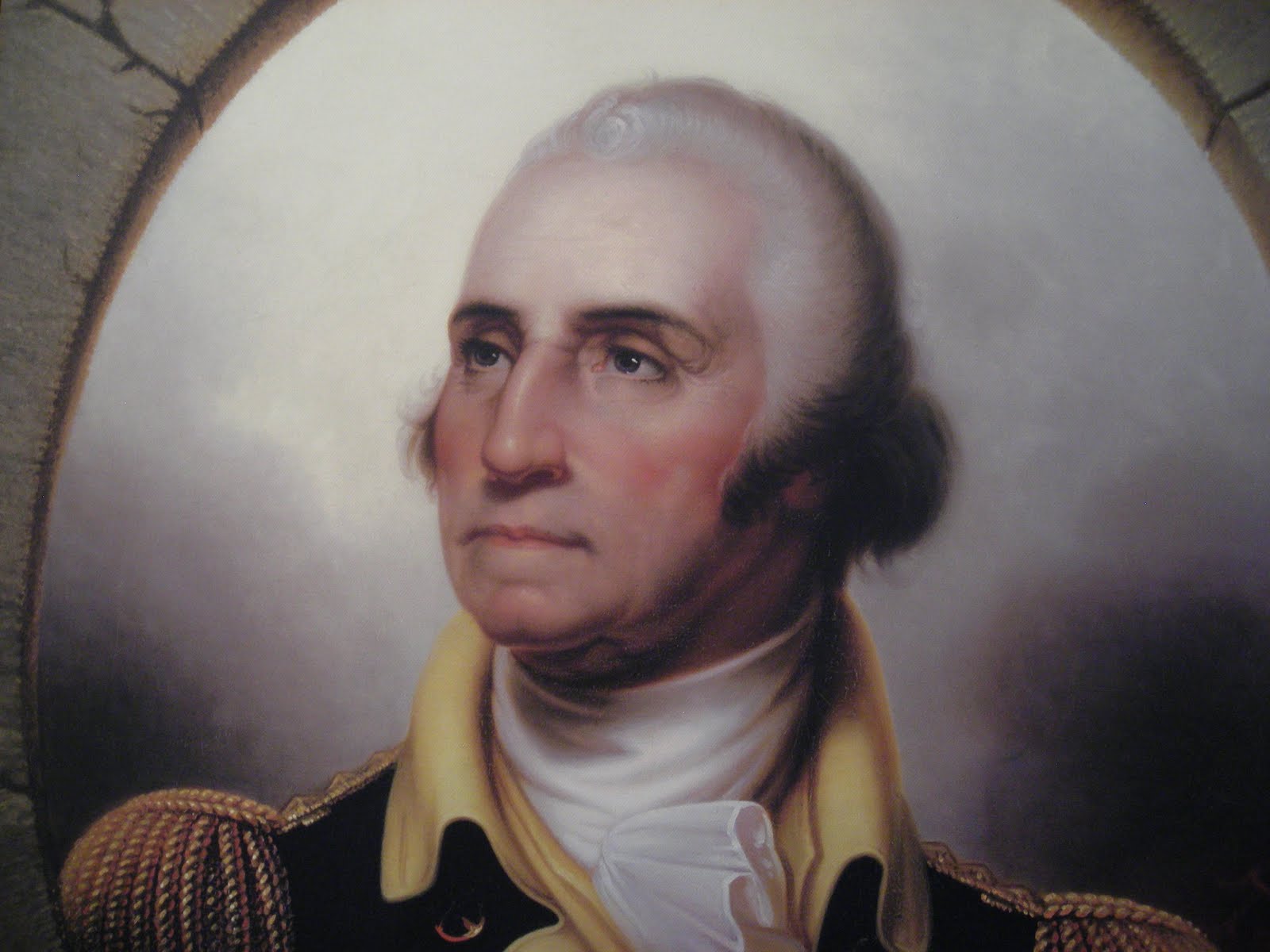
George Washington

Mount Vernon

A year and a half after our first visit to Mount Vernon, we returned to mitigate our failure to visit the mansion during our first visit in 2009. It was a brilliant spring morning but uncharacteristically cool for late April.

Our experience started out quite differently than last time – the reason we skipped the mansion tour in September 2009 was because it was drizzling, chilly and the line waiting to get into the mansion was long — and outside.

But this time, we learned that the long lines are a thing of the past. Now, the staff hands out timed entry tickets, so you’re free to wander around the grounds — the very informative grounds (in fact, much more so than the actual mansion tour, but we’ll get to that shortly) — while you wait the half hour or two hours to get in.

We arrived early enough (9:30 a.m.) so that we could go directly to the mansion. Sadly, though, buses filled with tour groups had already started lining the end of the George Washington Parkway.

Maybe we’ve been spoiled by visiting presidential houses during off-peak seasons and so tour guides have had more time to spend with us. And granted, Mt. Vernon is the most visited of all presidential houses — about one million people each year visit Mt. Vernon, compared with 450,000 at Monticello. But our tour of the mansion was comparatively disappointing.

The Mansion 'Tour'


Prior to entering the mansion, a female guide briefed us on the rules of the mansion. First, no pictures and no cell phones. Then we were told NOT to ask questions during the tour. This is apparently because the answers might take too long. Then she told us that they don’t allow pens in the mansion, which means no note-taking. When we told her that Monticello has no such rules, she said that this is Mount Vernon and they have different rules (It would have been helpful if she had given a real explanation, like they’re worried about graffiti). So we were left to our ability to recall — a talent that Cathy possesses more than Tom.

There are really no “tours” of the mansion but rather a line of people snaking through rooms. Guides are stationed at strategic points to give a one-minute narrative that they repeat almost immediately. Few details and no interpretation are offered. We were asked not to linger and to move along with the crowd.

But still, we got an idea of the home life of George and Martha Washington in the year 1799, the last year of George Washington’s life.

The first and most impressive room is the dining room, painted in Large Dining Room Green and Large Dining Room Verdigris. (We know this because the gift shop sells these paints through Fine Paints of Europe, in addition to Houdon Grey, Globe Thistle, and Cistern. It kind of cracks us up that they have ‘Europe’ in the title, but it is an American company.) The ceiling is decorated with images of farming tools because Washington, as we had discovered on our first visit, considered himself a farmer first and foremost. The walls are decorated with four paintings of rivers — the Potomac at Great Falls, the Potomac at Harper’s Ferry, the Hudson River, and one unknown river. A painting of French King Louis XVI hangs on the wall — homage to France for its help in the Revolutionary War. Most of the items in the room are original, including the three vases that perch on the Italian marble mantle.

We snaked our way into the main hallway. The most interesting item is an enormous key hanging on the wall — the key to the Bastille. It is a gift from Marie-Joseph Paul Yves Roch Gilbert du Motier (better known as the Marquis de Lafayette) to Washington. We learned that Washington was like a father to the much younger Lafayette. One of the upstairs rooms we see next is the “Lafayette Room,” where Lafayette would stay on his visits.

Also upstairs is Washington’s bedroom containing the bed where he lingered dying for 36 hours, slowly suffocating to death, according to one of the guides. Washington had contracted what is now thought to be acute epiglottitis on his last ride around the plantation on a cold, rainy December day. Bleeding Washington for a total of about five pints of blood during his last hours probably didn’t help the situation.

Outside we were allowed to linger and ask questions of the guides. We asked one of the women her most frequent question. “The most stupid one,” she asks? Sure. “What’s up those stairs,” is her choice as the most stupid question. The guides have decided the best answer is “the basement.”

On a more serious note she said that her most interesting discovery about Washington is that he had a sense of humor. As evidence she mentions one of the approximately 20,000 letters he wrote during his lifetime. In this particular letter he wrote to a European friend about the institution of marriage and said that in this country we customarily only do it once. (I think that most people — including presidents — have a sense of humor. It’s just that the evidence may not have survived.) She also mentioned another letter to his family, written in the midst of the Revolution, where he advises them to be sure to thin the carrot crop.

We asked another guide his opinion of Washington. He said that Washington was a “humble” man who could have been an “emperor like Cromwell” had he so chosen. He is not the first guide we have encountered on our travels who thinks that this is Washington’s true legacy. Washington could have continued serving as president and basically been king, but instead chose to step down at the end of two terms and let the new American citizens vote for a new leader.

Washington and Slavery
Washington had more than 300 slaves running the Mount Vernon plantation as well as four outlying farms.

During our previous visit, we had visited the 1983 slave memorial erected by Howard University. However, we didn’t see until now the 1929 slave memorial placed by the Mount Vernon Ladies Association, which runs Mount Vernon. It was the first memorial of its kind in the United States and it was to their credit that they erected the memorial. It was to their discredit that they called the slaves “faithful colored servants.”

We viewed a slave cabin on the grounds close to the river. The cabin consisted of a single room with a mud floor, a straw-filled mattress on one side, and a fireplace and cooking area on the other. Signage indicated that such cabins could have held a family of eight including a husband and wife who worked on two different farms several miles apart on the Mount Vernon property, forcing them to be separated six days per week. One day per week, the husband would walk the five miles to spend Sunday with his family.

Washington willed his slaves to Martha with the stipulation that they be freed upon her death. Although she freed his slaves prior to her death, she was unable to free all the Mount Vernon slaves since some were held in trust for her children (from her previous marriage) and therefore was not legally allowed to. To make matters more complicated, some of those freed slaves had intermarried with others who were not.

George Washington, Farmer
George Washington’s passion was working his farm. He successfully experimented with crop rotation using a seven-year cycle. He also designed a 16-sided grain thrashing building, a replica that now stands on the grounds.

He was also a farmer of fish. When the fish were migrating in the Potomac River, his slaves were directed to harvest and process the fish to eat and sell. The fishermen were able to catch enough during the fish season to feed everyone on the plantation for the entire year.

Visitors to Mount Vernon can walk down a trail to a pier on the Potomac River, where boat tours are offered. There also is a working farm, where Colonial-dressed interpreters cook vegetables and beef in a pot over a fire (even in the sweltering sun of the Washington summer).

Museum and Education Center
On this visit, we visited the museum, which we had missed last time—we had only toured the Education Center during our first visit. The highlight is a bust of Washington created by renowned French sculpture Jean Antoine Houdon in 1785 and is considered the most accurate likeness of Washington that exists. Houdon had turned down a commission from Catherine the Great to create this work. As part of the creation process, Houdon created a life mask of Washington, which he used to complete the bust. The bust was later used to create a statue of Washington in the Virginia state capital in Richmond.

The museum also contains many original works of art. The ones that most impressed me were those depicting the activities at Mount Vernon. One shows Washington and Lafayette deep in discussion on the porch of the mansion. Lafayette leans against the same pillar we had sat next to earlier that morning. Another shows Washington, Patrick Henry, Alexander Hamilton, and James Madison seated around a table on the grounds of the mansion. It is a snapshot of some of the most important people in American history.

Visiting Mount Vernon
The tour of George Washington’s home is definitely not worth the $15, but the rest of the plantation is.

Visitors easily can spend several hours wandering around the plantation, which is fortunate, since the mansion tour takes maybe 15 minutes. In addition to the educational center and museum, visitors can roam the trails, visit replica stables and barns complete with farm animals, visit George Washington’s tomb, and the slave memorial. They also can wander down to the Potomac and visit the small working farm.

Ground has been broken for a new library on the site, as well.

And be sure to linger on the chairs on the mansion’s porch overlooking the Potomac River. The view is spectacular — the “viewshed” was recently protected so that no development can be built across the river — and the chairs are comfortable. All that’s missing is some lemonade and cookies.

Which brings us to — eat at the Mount Vernon Inn, if you get a chance. The food is good and isn’t particularly expensive. A tasty and huge pulled pork sandwich with homemade potato chips cost a mere $8.50, for example (cheaper than buying lunch in downtown D.C.). The salmon corncakes were also large and delicious, for $11.50. But be warned, the inn stops serving lunch at 2:30.

References
White McKenzie Wallenborn, W.M. 1997. George Washington's Terminal Illness: A Modern Medical Analysis of the Last Illness and Death of George Washington

Saturday, September 26, 2009

George Washington

Mount Vernon


“It’s raining. I so don’t understand why we’re doing this,” Cathy said as we drove through a light drizzle south on the George Washington Parkway toward Mount Vernon, Virginia.

We had chosen this day, gray and with a 100 percent forecast of rain, to start the Presidents Project.

What a more fitting way to start than a visit to Mount Vernon, Washington’s home for 40 years. (Sure, we could have gone to the Washington Monument in D.C., but the giant obelisk wasn’t constructed until 1885, so it didn’t fit our criteria of being important to the president himself.)

Location
Mount Vernon is about eight miles south of Washington, D.C., along the Potomac River (or “Potowmack,” back in Washington’s day).

Entrance
We entered the grounds through the Texas gate, which was commissioned by the Texas Freemasons in 1899 and dedicated to fellow Freemason, George Washington.

Entrance to the expansive Mt. Vernon estate will cost you $15 ($14 for seniors, $7 for youths). That gets you a tour of the mansion, visits to the numerous buildings on the 200 acres of grounds, the gardens and the spectacular views of the Potomac River. Sitting on the green, high-backed chairs on the back porch of the mansion, overlooking the Potomac, might alone be worth the price of admission.

Mount Vernon is owned by the Mount Vernon Ladies’ Association who purchased it in 1858. Thus the need to purchase tickets. (The idea of buying tickets to museums and historical spots is odd for Washingtonians, like us, who grew up with the free Smithsonian museums).

Orientation Center
The Orientation Center holds two theaters, a model of the Mansion, stained glass images of Washington’s life, life size bronze statues of George and Martha Washington and two grandchildren. We were ushered into a movie theater to see two short films. The first was an introduction to Mount Vernon hosted by Pat Sajack (of “Wheel of Fortune” fame). The second, a live-action 18-minute overview of the Revolutionary War years, is not bad, with the actors actually spouting believable dialogue.


The Estate
First a confession: We didn’t go into the mansion itself. The line was just too long. Instead, we walked to the porch at the back of the mansion, sat in wooden, green chairs and admired the view of the Potomac River and the Maryland shore.

The grounds of Mount Vernon are huge and include 200 acres of buildings and fields.
Wandering around Mt. Vernon, what impressed us most was the self-sufficiency of the estate: The plantation workers grew, fruits, vegetables and wheat; they raised sheep, cows and other farm animals; they fished along the banks of the Potomac. An interesting tidbit about Washington is that he was somewhat obsessed with creating “live fences” (hedges and trees) around the property to keep out wild beasts.


Most of the work on the plantation was done by slaves—More than 300 by 1799--who now have been memorialized with a monument on the grounds where 150 slaves are thought to be buried. Mt. Vernon holds a ceremony on the anniversary of the erection of the slave memorial in September 1983 to pay tribute to the slaves and their descendants, many of whom attend the event. Coincidentally, we caught the tail end of this year’s service. (We didn’t know about it until we arrived). A purple-clad gospel choir of African Americans sang the phrase, “I don’t believe” as they filed out of the memorial site and tossed branches of same kind on the memorial. Allie Johnson King, 104 years old, was one of the slave descendants who came to the ceremony. She was pushed in her wheelchair accompanied by four additional generations of her descendants. They politely posed for pictures.

Among the highlights of the plantation is the tomb that holds the bodies of George and Martha Washington and 25 relatives. During the Civil War, Mount Vernon (which was in the South) was declared a neutral ground. Soldiers from both the North and South would leave their guns at the gate and pay their respects to Washington. A docent told us that the soldiers carved their names into the bricks. However, the carvings were so intricate that it didn’t seem possible that they were original. Plus, the dates didn’t match those of the Civil War. (A dead giveaway.)

Museum and Education Center
The new Museum and Education Center is exactly that – educational. It is an impressive display of facts and films about Washington’s life. Particularly impressive is a reverse 3-D likeness of Washington’s face that appears to look at you no matter where you stand. Another don’t-miss is the interactive movie theater. During the 14-minute movie, the seats vibrate as cannons are shot and imitation snow falls during the Valley Forge scenes. The Education Center also houses Washington’s famous dentures--surprisingly realistic. (We had been brought up on the tale of the wooden dentures. But these dentures were made of ivory.)

The center is devoted mostly to Washington’s war-time heroics and Mt. Vernon itself, and very little to his presidency. The characteristic that most impressed us was his unwavering fortitude and leadership. During the Revolutionary War, he was somehow able to convince a beaten army of sick, underfed, ill-clothed troops to cross the Delaware River in the middle of Christmas Eve night of 1776, march nine miles in the snow, and finally attack Hessian troops in Trenton, New Jersey. And win. He managed to accomplish this without losing a single person and captured 900 Hessian troops to boot. This is one of many stories of Washington’s perseverance and flat out bravery.

Washington’s main accomplishment during his two terms ((1789-1793 and 1793-1797) was to stabilize the new nation – not easy since the North and South were already fighting over such major issues as power of the federal government vs. power of the states as well as slavery.

He created the first Cabinet, with many of the same posts that we still have today: Department of State (Thomas Jefferson), Department of Treasury (Alexander Hamilton), Secretary of War (Henry Knox), and Attorney General (Edmund Randolph). He appointed the Supreme Court, led by John Jay as Chief Justice. He established the Bank of the United States and began work on creating Washington, D.C., as the nation’s capital. He even declared Thanksgiving as the first national holiday. And his military exploits were not over. In 1791 he led 13,000 militia men against the whiskey tax protesters in western Pennsylvania. The show of force caused the rebellion to evaporate with no bloodletting. Perhaps his biggest accomplishment was to avoid another war with Great Britain by sending Chief Justice John Jay to England to negotiate a truce—at terms that were less than favorable to the United States. This cost Washington some of his popularity but gave our young nation time to strengthen before the War of 1812.

Initially, some called for Washington to be crowned king. It is to his credit that he resisted such calls and became president. It also is to his credit that he did not run for a third term (which he would have won handily) and instead retired to his farm, where he died two years later.


Writings
George Washington was a prolific writer. A collection of his writings (Rhodehamel, 1997) covers more than 1,000 pages.

To his nephew, George Steptoe Washington, he advised (March 23, 1789): “ The first and great object with you at present is to acquire, by industry and application, such knowledge as your situation enables you to obtain, and as will be useful to you in life. In doing this two other important objects will be gained besides the acquisition of knowledge—namely, a habit of industry, and a disrelish of that profusion of money & dissipation of time which are ever attendant upon idleness. …When you have a leisure to go into Company that it should always be of the best kind that the place you are in will afford; by this means you will be constantly improving your manners and cultivating your mind while you are relaxing from your books; and good Company will always be found much less expensive than bad.”

To his step granddaughter, Eleanor Parke Custis, he wrote of love and marriage (January 16, 1795): “Love is said to be an involuntary passion, and it is, therefore, contended that it cannot be resisted. This is true in part only, for like all things else, when nourished and supplied plentifully with aliment, it is rapid in its progress; but let these be withdrawn and it may be stifled in its birth or much stinted in its growth. For example, a woman (the same may be said of the other sex) all beautiful and accomplished, will, while her hand and heart are indisposed of, turn the heads and set the circle in which she moves on fire. Let her marry, and what is the consequence? The madness ceases and all is quiet again. Why? Not because there is any diminution in the charms of the lady, but because there is an end of hope.”

To John Price Posey he unleashed his anger on the disposition of the estate of one of his wife’s relatives (August 7, 1782): “If what I have heard, or the half of it be true, you must not only be lost to thee feelings of virtue, honor and common honesty; but you must have suffered an unwarrantable thirst of gain to lead you into errors which are so pregnant with folly and indiscretion, as to render you a mark for every man’s arrow to level at….Conscience, must have kicked out of the doors before you could have proceeded to the length of selling another Mans Negros for your own emolument…Conscience again seldom comes to a Mans aid while he is in the zenith of health, and reveling in pomp and luxury upon ill gotten spoils; it is generally the last act of his life and comes too late to be of much service to others here, or to himself hereafter.”

To his sister, Betty Washington Lewis, regarding his mother death (September 13, 1789): “Awful, and affecting as the death of a Parent is, there is consolation in knowing that Heaven has spared ours to an age, beyond which few attain, and favored her with the full enjoyment of her mental faculties, and as much bodily strength as usually falls to the lot of four score….It will be impossible for me at this distance, and circumstanced as I am, to give the smallest attention to the execution of her will…The Negros who are engaged in the crop, and under an Overseer must remain I conceive on the Plantation until the crop is finished..after which the horses, stock of all sorts, and every species of property, not disposed of by the will…must by law be equally dived into five parts, one of which you, another my Brother Charles, and third myself, are entitled to.


Rhodehamel, J. (ed.) 1997. George Washington Writings. The Library of America.

Saturday, January 1, 2000

Introduction

Everyone learned about the U.S. presidents back in grade school — around the same time we were learning our state capitals — but only a very few remember anything beyond the basics. George Washington cut down the cherry tree. Thomas Jefferson built Monticello and the University of Virginia. Franklin Delano Roosevelt’s building programs helped get us out of the Great Depression. Richard Nixon was forced to resign after the Watergate scandal. But not many of us know or remember much beyond that.

So we had an idea to re-learn our presidents. The idea is simple, yet promised to take a while – visit a place important to each U.S. president and then write about it. It was part history, part travelogue, and we call it Presidential Pursuits. There were no rules, except one – we have to visit the important places in order of the presidencies.

This means we can't knock out the geographically proximate Washington, Jefferson, Monroe and Madison over a long weekend. Nor could we fly to Boston and take care of John Adams and his son, John Quincy Adams on the same trip.