Saturday, May 28, 2011

Philadelphia

Although we had gotten to know a little about our friends Washington, Adams, Jefferson, Madison, and Monroe; we felt that something was missing. We needed to see the place where these Founding Fathers had all gathered and created “the grand experiment” called America—we needed to visit America’s birthplace, Philadelphia. Since Cathy was attending her nephew’s first birthday in North Carolina, I, Tom, made the trip on my own.

Philadelphia is about 140 miles from our home in the Washington, D.C. suburbs, an easy 2.5 hour trip up I-95. The Philadelphia historical area is bordered by the Delaware River and 7th Street (east to west) and Race Street and Spruce Street (north to south). Since I had lived in Philadelphia in the late 1980’s, I knew my way around. I originally intended to save money by parking on the street but was not able to find a legal spot, so I opted for a parking garage. All day parking just outside the historical area was $17.50.

My main goal was to visit Independence Hall, since that is the place where both the Declaration of Independence AND the Constitution were conceived, created, and signed. So I headed immediately to the Independence Visitor Center to get my free entry ticket. But I got distracted as I walked down Chestnut Street.

The Signer
In a small park on Chestnut Street, right next to the Second Bank of the United States, stands a larger than life statue of a man of the Colonial era. He is called The Signer and he holds a document high overhead in one hand and flourishes a quill pen in the other. It is a dramatic pose.
I have always been interested in this statue. Why? Because when I lived in Philadelphia in the mid-1980s, I was friends with a man who claimed to be the model for The Signer. To this day, I don’t know if he was telling the truth. But he could strike The Signer’s pose dead on. That, and the date of the statue (1980) made me believe that his claim could be true. So I’ve decided that someone had to be the model for the statue, so why not him?

Independence Visitor Center
Once I had taken the obligatory shots of The Signer, I scurried off to the Independence Visitor Center to get a mandatory ticket to Independence Hall. Tickets are issued that allow entry to 80 people every fifteen minutes from 9 a.m. to 5 p.m., roughly 2,500 tickets per day. When I arrived at the Visitor Center it was 11:30 a.m. and they were running low on tickets. My brief stop at The Signer might cost me. When I got to the ticket counter, they had but five more tickets--I had made it with seconds to spare. However, I would have to wait until 4:30 for the tour. But that was no problem; I was happy just to get a ticket. Plus there are plenty of other sites to see.

The Visitor’s Center has two small movie theaters, both of which I visited. One shows a 20 minute film called Choosing Sides. The film describes four young characters of the Colonial period who must make decisions about their loyalties: a patriot, a loyalist, a Quaker, and the last can only be described as the fence sitter (but I can’t be sure since I fell asleep and missed this part.) The second theater shows a 30 minute film called Independence. Hollywood director, John Houston, is the director. The film begins as a zombie show as several key figures from the Revolutionary era literally return from the grave: Benjamin Franklin, Thomas Paine, John Adams, Abigail Adams, Thomas Jefferson, and Benjamin Rush. James Madison, the Father of the Constitution, is unjustly neglected and only has a cameo. For most of the film, the actors are bathed in a fog to represent the unholy act of the rising from the dead. Following the re-enactment of the signing of the Constitution, Ben Franklin returns to the grave with the mournful warning, “you have a Republic if you can keep it.”

Predidents' House
Just across the street from the Visitor’s Center is an open air exhibit on the site of the house that both Presidents Washington and Adams rented during 1790-1800 when the capital was in Philadelphia. They rented the house from Robert Morris, a wealthy patriot who sadly ended up in debtor’s prison. The exhibit sits atop the glass enclosed foundations of the original house, now 10 feet below street level. The house is but a five minute walk from where the Congress met in the Pennsylvania State House next to Independence Hall.

Strangely, the majority of the exhibit is devoted to the evils of slavery. I’m not sure why such an exhibit is located at that particular spot, but I guess it’s as good a spot as any to highlight this evil practiced by four of the first five presidents. The slavery exhibit focuses on the slaves owned by Washington and his wife, Martha. Under Pennsylvania’s “gradual emancipation” law at the time, slaves brought in from out of state could claim their freedom after six months. However, clever slave owners such as Washington, rotated their slaves out of state so that they could not claim their freedom. In addition, Washington signed the Fugitive Slave Act which required the return of slaves who crossed state lines.

One of the Washington’s slaves, a woman named Oney Judge, did manage to escape while in Philadelphia. President Washington had his steward, Frederick Kitt, run an advertisement for her capture. “Ten dollars will be paid to any person (white or black) who will bring her home….” (She was never caught and lived to a ripe old age in New Hampshire.)

Carpenter’s Hall
This relatively little known building is a must see. Not because of what it looks like, but because of the four major events that happened there. First, the First Continental Congress met here in the fall of 1774 to discuss their grievances against England following the passage of the so called Intolerable Acts. (The Intolerable Acts were a series of acts passed by Great Britain in response to the Boston Tea Party. These acts called for the closure of Boston Harbor, stronger control over the Massachusetts government, restrictions on the trials of royal officials, and quartering of troops in the homes of private citizens.) That Congress consisted of representatives from 12 of the 13 colonies. Georgia did not attend because they needed England’s help in dealing with their Indian problem at the time. This First Continental Congress drafted the Articles of Association, which restricted trade with England.

Second, in December of 1775, John Jay, Benjamin Franklin, and Francis Daymon met with Julien Achard De Bonvouloir of France to discuss French military support for the Revolution. France, an avowed enemy of the British, was eager to assist the colonies. The meeting was held in tight secrecy because France, obviously, did not want the British to know of their possible involvement.

Third, in June of 1776, an “Extra-Legal Body” of Pennsylvania citizens declared the official Pennsylvania Assembly invalid and opted to join the other colonies in the fight against England.

And last, this building was the temporary site of the First Bank of the United States until the actual First Bank building was constructed a few blocks away. The original vaults still exist in the basement.

The building, which has been in continuous use for more than 230 years, still contains some original Windsor chairs from the First Continental Congress. The Carpenter’s Company, consisting of 180 professional in the building, engineering and architectural professions, still meets here.

First Bank of the United States
The First Bank of the United States is not open to the public so I could only admire it from the outside. The Romanesque building is a monument to Alexander Hamilton who fought hard for a national bank. The bank enabled the states to combine their Revolutionary War debt as well as create a common currency. The South resisted the notion of a Federal bank claiming it was unconstitutional. However, George Washington signed a bill chartering the bank in 1791.

Second Bank of the United States
Because the charter for the First Bank ran for only 20 years, it expired during the term of James Madison. It took another half decade and the accumulation of additional war debt (from the War of 812) to convince Congress to charter the Second Bank in 1816.

The Second Bank building, modeled on the Parthenon, was open. It is now a gallery containing the portraits of dozens of the major figures of the Revolution. A majority of the portraits are by Charles Wilson Peale but there are others by Gilbert Stuart and Thomas Sully. The building also contains a large statue of George Washington by William Rush. There is also a full length painting of Lafayette looking regal in his cape.

Old City Hall
The Old City Hall, located next to Independence Hall, housed the Supreme Court from 1791 until 1800. It looks much like the modern courtroom of today except for the prisoner’s box in the middle of the room. One of the park rangers remarked that many people think the first Chief Justice was John Marshall but it was, in fact, John Jay, the co-author of the Federalist. John Marshall actually argued a case here and lost. The only original furnishing remaining is the Chief Justice’s uncomfortable looking wooden chair.
Congress Hall (Old name: County Courthouse)
On the other side of Independence Hall is the County Courthouse, now called Congress Hall. It was in this building that Congress met for the first ten years of the new republic (1791 to 1800). Here also the First Bank of the United States was originally established (1791), the Navy established (1798), and the Alien and Sedition Acts passed (1798).

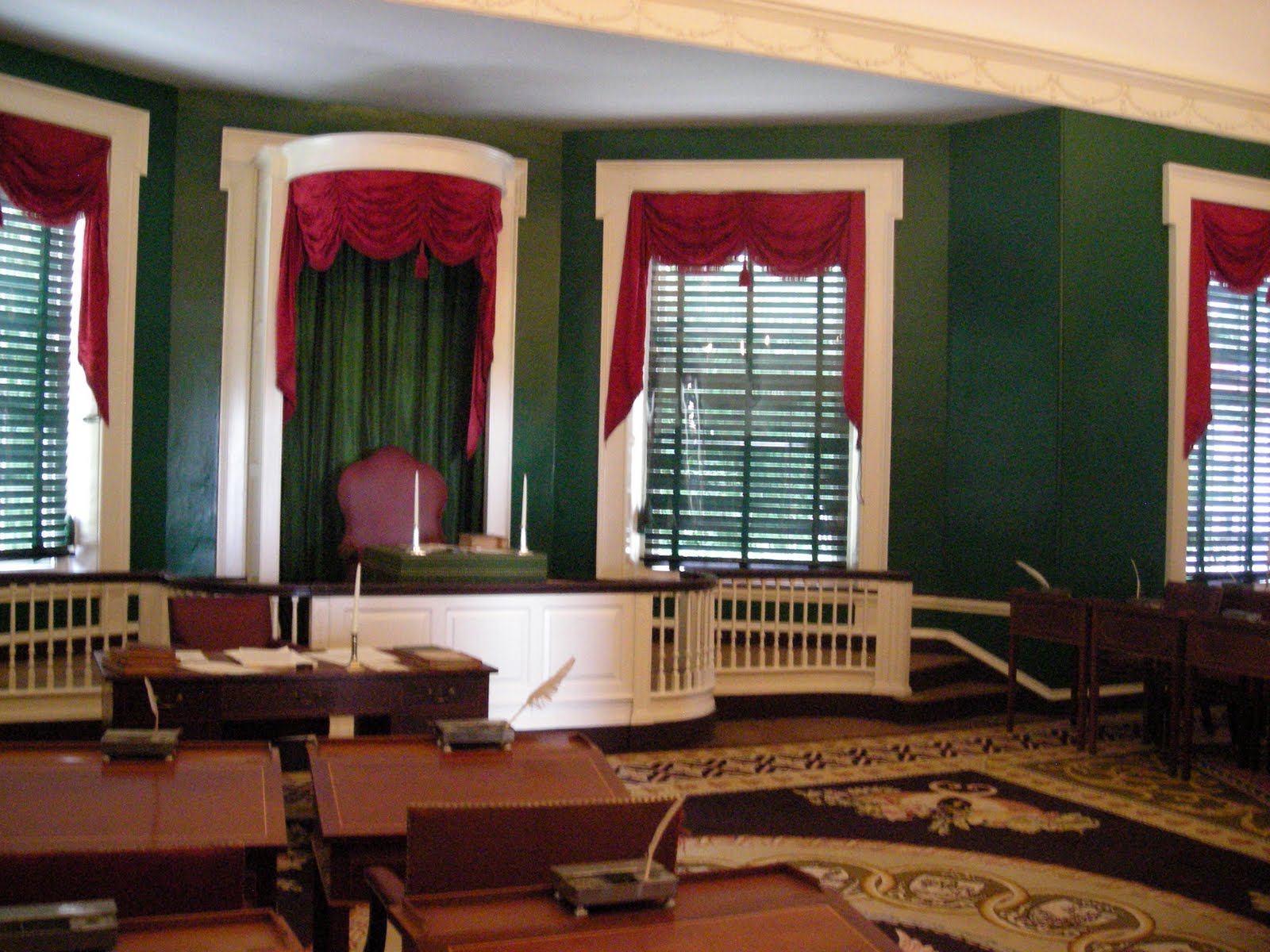
The House of Representatives met downstairs and the Senate met upstairs. The House of Representatives had a similar configuration to that of today with much room for mingling and listening to debates. The Senate Chamber upstairs is smaller but more impressive. The Great Seal of the United States, created in 1782, is painted on the ceiling. The eagle holds arrows in one claw and an olive branch in the other. The eagle’s head faces toward the olive branch, symbolizing the United States’ preference for peace while always being prepared for war.

Great Essentials Exhibit
In the west wing of Independence Hall is the Great Essentials Exhibit which contains original copies of the Declaration of Independence, Articles of Confederation, and the Constitution. (I’m not sure what an “original copy” actually is.) The light is kept low to preserve the documents, making them difficult to view. However, it was nice to be so close to these historical documents. (No tickets are needed to view this part of Independence Hall.)

Independence Hall (Pennsylvania State House)
And then finally it was time to visit Independence Hall. All day I had been thanking my good fortune for snagging one of the last tickets for the tour. However, as I waited in the line to enter the building, I learned that the Park Service allows people without tickets to get in if the 80 person limit had not yet been reached during any quarter hour segment. During my tour, they let in about 50 people without tickets—so I could have easily scored a tour without a ticket.

Much of Independence Hall is original but it was reconstructed in 1828. It is currently undergoing renovation and the clock tower is covered in scaffolding.

The highlight of Independence Hall is the Assembly Room where the Second Continental Congress met from May 1775 until December 1776. In this room sat many of the same delegates as the First Continental Congress with the addition of such luminaries as Benjamin Franklin and Thomas Jefferson. It was here that the Declaration of Independence was conceived. Our guide, Larry, said that Thomas Jefferson wrote ninety percent of the Declaration of Independence. (I was disappointed that he didn’t give credit to the other authors: John Adams, Roger Sherman, Robert Livingston, and Benjamin Franklin.) The Declaration was accepted here on July 4, 1776 and on July 8, John Nixon read the Declaration of Independence in State House Square (now called Independence Square). Following the reading the King’s coat of arms was burned.

That same summer, the Congress began work on the Articles of Confederation. This was a document that outlined the governing of the new states. It was put to the states for ratification in 1777 and passed by 1781. However, the Articles of Confederation was a weak document that only loosely regulated the states and did not allow for the collection of taxes. Without funding, the government could not operate.

In the summer of 1787, delegates from the 13 states met in this room to fix the Articles of Confederation. James Madison was successful in arguing that the Articles of Confederation needed to be replaced and not amended. This gathering became known as the Constitutional Convention. Notables from past Congresses, John Adams and Thomas Jefferson were absent. However, James Madison convinced George Washington to attend and Washington was quickly elected as president of this Constitutional Convention. He sat in what later became known as the Rising Sun chair. The term was coined by Benjamin Franklin who pronounced the carving of the half sun on the back of the chair as a rising rather than a setting sun, representing the rising of the American republic. On the 17th of September 1787, the Constitution was signed by the delegates and put forward to the states for ratification. (The ratification was completed by June 1788.)

Following the tour, I asked Larry, who is African American, “What is the most meaningful thing for you ”? He said the most important thing for him was the Founders’ ability to compromise to move the Constitutional process forward. They realized that they would have to compromise on slavery or no deal on the Constitution was possible. They had to do the same with state’s rights, although I believe these two issues are closely linked. Larry was also taken by the amendment process that allowed the Constitution to accommodate new information and interests.

Liberty Bell Center
Because the long line of earlier in the day had disappeared, I made a quick stop at the Liberty Bell Center. (Hint: you can actually view the bell from the outside the building through a special window designed for the purpose.) Inside, a series of exhibits describes the history of the Liberty Bell and how it had been subsequently used world-wide as an icon for freedom. During World War Two, the Liberty Bell icon was prominent on Liberty Bonds used to raise money for the war effort. The bell, with its prominent crack, is placed at one end of the Center and is constantly guarded by a National Park ranger. (The bell was attacked by a person with a hammer not long ago.)

Final Thoughts
On Slavery.
It is the human condition to view history backwards rather than forward. But sometimes we should try to view it from the perspective of those we study so that we can better understand their viewpoint. So, to understand the actions of the Founding Fathers we need to look at history from their perspective, not ours. Each was born into a pre-existing culture and were shaped by it, just as we are by ours.

The institution of slavery—principally to provide labor for plantations—was deeply entrenched in southern colonies when the Founders were born and raised. The Virginians—Washington, Jefferson, and Madison—were raised in this slave dependent culture while John Adams, whose father was a Massachusetts preacher, was not. Although the Founders were outraged enough to challenge the intolerable yoke of British oppression, most had no similar outrage against slavery. Most seemed to be disturbed by it, but not profoundly. They were unwilling to challenge slavery in any meaningful way.

One very important thing to remember is that the delegates from the southern colonies were immovable in their support for slavery. All the delegates to the Constitutional Convention were aware that—in the near term—there would be no challenging the concept of slavery without also destroying the creation of the Constitution.

On Memorial Day. Since it was Memorial Day weekend, Larry reminded us that owe our freedom to George Washington and his soldiers. That is a good ending to this day.

Saturday, May 14, 2011

James Monroe, President No. 5 (1817-1825)
Ash Lawn 

It was a drizzly cool May day when we found ourselves yet again in the pursuit of another president — this time James Monroe. To see his plantation, Ash Lawn, we needed to retrace our steps from last January; Ash Lawn is just a few miles from Jefferson’s Monticello, outside Charlottesville, Virginia. (This is no coincidence, but more on that later.)

The admission was $12.00 for each adult ticket but they threw in a nice AAA discount of $1.00 for us. There is no museum per se at Ash Lawn, hence no movie to give us a sense of the man (and a chance to nap). There is a museum at his birthplace, just outside Fredericksburg, Va.

Note that the home has not always been called Ash Lawn. It was called Highland in Monroe’s day. Subsequent owners renamed it Ash Lawn for the majestic ash trees that line the entrance drive.

We were greeted at the house by Allison, a self-proclaimed history buff. She was extremely knowledgeable, but Tom had a hard time following her rapid-fire delivery. Cathy was forced into the note-taking role.

The first thing we learned is that the majority of the house is not from Monroe’s era. It is only the “white” portion of the home that is original. It consists of five rooms on a single floor.

As noted above, it is no coincidence that Monroe lived so close to Jefferson. He sought to live close to his friend (and father figure), who in fact selected the house site for Monroe. James and his wife, Elizabeth, occupied the house from 1799 to 1823 — except for their eight years in the White House.

What we would call the living room holds an original bust of Napoleon. The bust was a gift to Monroe, who negotiated the Louisiana Purchase with France while serving as Jefferson’s Minister to France.

The house has many portraits and paintings. Among them are portraits of Washington, Ben Franklin and a print of the signing of the Declaration of Independence – according to tour guide Allison, it was fashionable in the late 1700s and early 1800s to have those three pieces of art hanging in your house.

Highland was pretty small, compared with Monticello and Montpelier. So Monroe didn’t have many house guests. However, James and Dolly Madison, who lived about 30 miles away in Orange, were the first overnight guests. The Marquis de Lafayette also stayed with the Monroes, sleeping in a guest house near the main house. As Allison said, “Lafayette slept everywhere in Virginia.”

Under the house, we visited the kitchen. We learned that the Monroes were the first family in the U.S. to have a waffle iron. They also had a cookie press, which had George Washington’s likeness on it – Pillsbury would be jealous.

We also learned about tea bricks. Tea leaves were very expensive and tea bricks were much cheaper. Yes, they are bricks of tea. Kitchen help would grate off the tea leaves from the brick with something like a lemon grater and then put that into a tea cup. Each square is called a cachet, and each cachet would make 20 cups of tea.

Outside the house, we wandered the rather small but nice grounds and eventually found ourselves in the old ice house. There another guide, Gerald, was giving a lecture on Monroe’s role in the expansion of the United States. Monroe negotiated the Louisiana Purchase for $15 million while serving as Jefferson’s Minister to France.

Who was James Monroe?
Monroe held more political offices than any other U.S. president: Virginia state delegate, member of the Continental Congress, U.S. senator, ambassador to France, Virginia governor, Secretary of State, Secretary of War, and, of course, President.

Throughout his life James Monroe preferred to be called Colonel. He was the first veteran since Washington to be elected president. His Revolutionary War credentials are deep. In December 1776, he crossed the Delaware twice with General Washington--first as a scout and second as a combatant. He was wounded in the Battle of Trenton the next day. He also joined General Washington at the infamous winter at Valley Forge (1777-1778).

Monroe began his political life in 1782 when he was elected to the Virginia General Assembly. He served at the Confederation Congress in Philadelphia from 1783 to 1786.

Allison told us that Monroe is the only person to be fired by two different presidents. He was fired by President Washington for favoring the French too much when John Jay was negotiating “Jay’s Treaty” with Great Britain. Monroe loved France and hated Britain, which obviously was an issue when negotiating treaties and walking a fine line between the two countries, which were constantly quarreling--and the U.S. hadn’t decided yet whose side to take in their spats.

Monroe also was fired by President Jefferson for not negotiating a favorable treaty over Britain’s impressment of American sailors. Monroe had actually negotiated a treaty with Britain in 1806 that would have ended the slave trade in both countries, but Jefferson didn’t like the language regarding the impressment issue. Britain agreed to stop taking American sailors, but the treaty didn’t explicitly say that Britain “didn’t have the right to take” American sailors. Jefferson was furious and refused to send it to the Senate for ratification.

Monroe also served as Secretary of State under President Madison and later was appointed to the second position of Secretary of War.

James Monroe was the last Founding Father to be elected President. He was first elected as President in 1816 and was re-elected in 1820. He is the only president besides George Washington to run unopposed. However, he lost one vote in the electoral college when an elector from New Hampshire voted for John Quincy Adams—the next U.S. president—instead.

Monroe had many legacies in his two terms as president, some large, some small.

His first legacy is probably the expansion of the U.S. during his two terms in office. As president, he bought Florida and parts of Alabama, Mississippi, and Louisiana from the Spanish for $5 million.

He was a tireless proponent of national security and reached treaties with every major power. He convinced Congress to fund a system of coastal fortifications and built forts all along the coasts to protect the U.S. from foreign enemies. He also secured the border with Canada, which was owned by Britain. He vowed never to allow the United States to be attacked as it had been by the British during the War of 1812 when they were able to easily reach Washington, DC and burn it.

In 1820, President Monroe faced the so-called Missouri Compromise, a bill that allowed Missouri to join the Union as a slave state but restricted slavery in future states that were located above latitude 36°30′ north. This was 30 years after the Compromise of 1790 that located the nation’s capital in the slave holding south in exchange for the establishment of the First United States Bank. These compromises were leading inexorably toward the Civil War.

It is prescient that during the contentious Congressional debates, Georgia Congressman Thomas W. Cobb screamed at New York Congressman James Tallmadge, Jr. that “if you persist, the Union will be dissolved. You have kindled a fire which all the waters of the ocean cannot put out, which seas of blood can only extinguish.” Tallmadge replied: “ Let it come!” And it would…40 years later (May, 2008).

His most enduring legacy is the Principles of 1823, which later became known as the Monroe Doctrine. These were actually three paragraphs in a speech he gave to Congress in December 1823. He thought the U.S. was too weak to fight lots of wars, so he thought a policy of sticking to affairs in the Western Hemisphere would be advantageous to the fledgling country. As well, South American countries were declaring their independence from Spain and Portugal and he wanted to keep them secure from recolonization. Essentially he told Europe to stay the heck out of the of the Americas and the United States would stay the heck out of Europe. (Not that the United States was actually powerful enough to do much in Europe.) (Historians are divided on how much of the Monroe Doctrine is attributable to Monroe and how much to his Secretary of State, John Quincy Adams.)

But other small legacies are important, too. For example, he was the first president to make rules about where people sat at dinner in the White House, a European custom. And his daughter Maria Hester was the first presidential daughter to be married in the White House.

Monroe struggled financially his entire life. Plantations were not big money makers, and Monroe suffered when tobacco prices dived. He did try to diversify, and ran a quarry, grist mill, blacksmith shop and added a sheep farm. He also started switching to wheat when tobacco prices fell. And one of his slaves was a spinner, who was able to make lots of money for Monroe with her woven goods.

But he was able to acquire a lot of land out west in poker games, since land often was used as payment. And he was able to exchange land grants for items he wanted to buy for the house.

Yes, we continue to be amazed by the lack of financial acumen by the Founding Fathers. Although Allison told us that Jefferson was actually a great financial adviser, though he was deeply in debt when he died.

Jefferson’s death affected Monroe, particularly the fact that Monticello and all of Jefferson’s belongings had to be auctioned off because he was so deeply in debt. At that point, Monroe started trying to get his financial house in order. Still, his son-in-law had to sell all of Monroe’s 3,000 books – and all of his slaves -- when he died.

It is worth noting that in the early days of the United States, the pay for public service was not high and public servants were required to pay much of their expenses out of pocket. According to Hart (2005), Monroe petitioned Congress and several presidents for unpaid expenses. His entreaties were largely ignored and he died destitute.

Following our tour we asked Allison her impressions of Monroe. She said that she was aware that many people think Monroe did whatever Jefferson and Madison told him to do. But she believes that he was very much his own man—although admittedly a better administrator and delegator than intellectual thinker.

Monroe’s French Connection
Monroe loved France, and you can tell by looking around his house. The design of the house, which was built by Jefferson, is French. Much of the décor inside is French, including the French wallpaper, which many rich colonists used to convey their status to guests. And Monroe’s French-designed serving pieces are in the White House. Monroe and his family were the only Americans to attend Napoleon’s coronation as Emperor of France in 1804. This is no coincidence since Monroe’s daughter, Eliza, was close friends with the daughter of Empress Josephine, Hortense, from a previous marriage.

Monroe was in quandary the first time he went to Paris. The French Revolution was underway, Robespierre had been to the guillotine, and the Republic had taken over. He didn’t know who to present his official diplomatic papers to, so he presented them to the Assembly, which was a first. (The French turmoil was advantageous to Monroe and Elizabeth, though – the Republic needed money and was auctioning off Louis XVI and Marie Antoinette’s possessions at Versailles, so the Monroes were able to buy lots of French stuff at a discount.)

Monroe and Slavery
Monroe did the most of the Founding Fathers to end slavery, but he never freed any himself.

He had about 30 slaves on his plantation doing everything from working the tobacco crops to spinning yarn and making candles. He, like Jefferson, thought slavery was evil but couldn’t figure out how to deal with it.

The big hang-up, apparently, was that he and other politically active slave-owners thought it was the state’s responsibility to pay landowners for freeing the slaves since the slaves were considered property. He also believed that freeing the slaves would lead to a never-ending race war. (While governor of Virginia, he quashed a planned 1800 slave revolt and had 26 slaves hanged including the instigator, Gabriel Prosser.)

The United States abolished the slave trade in 1808 when Monroe was Secretary of State under Madison. However, the law allowed states to decide what to do with any slaves captured from slave ships sailing from Africa caught off the states’ shores. And since slaves were valuable, selling slaves quickly became a good way for states to make money. Rhode Island, for example, was a big slave-trading state. And many New England states traded slaves down to the Caribbean since they didn’t allow slavery themselves.

And as the country expanded south and west, slaves became more valuable in those areas, where new and successful crops were being grown, such as cotton and sugar cane. Slaves sometimes were sold in New Orleans and Georgia for twice what they would go for in Virginia.

In fact, Monroe had a problem with slaves trying to run away. So he threatened to sell them to landowners in New Orleans, which had a much higher death rate than Virginia.

Skin color also determined the value of a female slave – the lighter skin the better, particularly in New Orleans. Why? Because light-skinned slaves could be used for prostitution.

And of course female slaves were more valuable than male slaves for the obvious reason that they could produce offspring. But also, their jobs were year-round since they did the kitchen and house work. Men worked the fields, but not in the winter.

Although Monroe never freed his own slaves, he did support the American Colonization Society, which established Liberia in West Africa as a place for freed slaves to colonize. Its capital was named Monrovia in his honor.

References
Hart, G. 2005. James Monroe. Henry Holt and Company. New York, NY.

May, G.  2008.  John Tyler.  Henry Holt and Company.  New York, NY. 

Unger, H.G. 2009. The Last Founding Father: James Monroe and a Nation’s Call to Greatness. Da Capo Press. Philadelphia, PA.

Sunday, January 9, 2011

James Madision

President No. 3 (1809-1817)
Montpelier The day after we toured Monticello, we were off to Montpelier, James Madison's estate in nearby Orange County. Now, Cathy is a graduate of James Madison University, in relatively nearby Harrisonburg, so she was particularly looking forward to this visit, since she never did a road trip during college.

Montpelier is in Orange, about 45 minutes outside Charlottesville, Va., on Route 20. Because the ground contains a horse race track as well as the mansion and visitor center, they collect the $16 entrance fee immediately upon entering the property.

We started off at the visitor’s center with a movie on the life of James Madison, our fourth president and also the father of the Bill of Rights.

Note: We highly recommend watching the visitor center films on your tours of the presidential estates. Tour guides have time to only tell you so much, and films are able to fill in many of the gaps.

Following the film, we walked over to the mansion about 5 minutes away and were met by Bob Davis, our tour guide, and two other visitors from South Carolina. (Note: A big advantage to visiting in the winter is that it is not crowded.)

The Mansion Montpelier has just undergone a five-year, $24 million renovation in which the mansion was brought back to its original size, and it now represents the house when the Madisons lived there, not when the DuPont family lived there and expanded upon it.

Currently, the house is devoid of furnishings — it looks like a house for sale where the owners have already moved out.

It seems Dolly Madison sold most of the house's contents as well as the house itself after the death of her husband to help drum in some quick cash. Archivists are now searching to find the original pieces or at the least to learn what types of furnishings were in the house so that they can purchase or build copies. They have had limited success, though, and the success they have had — red velvet wallpaper for the dining room, for example — has not come cheap.

One piece of furniture that historians are sure Madison used was a “campeachy chair.” This low-slung brown chair was a comfort to Madison, who suffered from severe rheumatism for most of his life. (It was a comfort to us as well: We found a replica of this surprisingly comfortable chair in a warm sunny room and Cathy used the opportunity to grab a quick nap. You'll notice a trend — we tend to sneak in a nap on most of our presidential visits. Don't even ask about art museums, but let's just say that any nice, dark film room in an art museum is visited early and often.)

Upstairs, gazing out on the Shenandoah Mountains from Madison's study, Bob pointed to dark spots on the wooden floor that he said were likely ink spots and might indicate where Madison’s desk had been. It was in this room that Madison reviewed the pros and cons of different governmental systems and developed the Virginia Plan prior to attending the Constitutional Convention in 1787.

In another upstairs room is a cutaway of one of the walls that showed the renovation nicely. When the archivists were working on the walls, they found mouse nests that contained pieces of paper from Madison's time — a most valuable finding, indeed.

His Life Montpelier already belonged to the Madison family when James was born in 1751. Like Jefferson, Madison was a bibliophile. He read all of his father’s books by the age of 11. Madison attended college at the far off College of New Jersey, now known as Princeton. (Unlike the other Virginian presidents, he did not go to nearby William and Mary.)

Constitutional Convention James Madison is considered the pivotal figure in the Constitutional Convention held in Philadelphia in 1787 to find a way to strengthen the confederation of states as outlined in the Articles of Confederation.

How did historians come to this conclusion?

--First, Madison was key in persuading George Washington to attend the convention. He (and others) believed that without Washington’s involvement, the public would not accept the results. --Second, prior to attending the Constitutional Convention, he spent the spring of 1787 studying world governments to learn what did and didn’t work. From his research, he developed the Virginia Plan.
--Third, Madison persuaded the Virginia delegation and eventually all of the delegates to throw out, and not merely amend, the Articles of Confederation.
--Fourth, Madison was the only delegate to attend every meeting of the Constitutional Convention.
--Fifth, Madison, with Alexander Hamilton and John Jay wrote The Federalist, a series of 85 newspaper articles that explained to the public the reasons for the Constitution.
--And finally, Madison led Virginia to ratify the Constitution over the objections of the brilliant orator Patrick Henry.

Bill of Rights Madison eventually came to the view that the Constitution gave too much power to the federal government. In 1789, he penned a series of amendments to the Constitution, of which the first 10 became known as the Bill of Rights. These include the freedom of speech, the right to bear arms, the freedom from self-incrimination, etc., that we know so well. In 1791, the amendments were ratified under the rules set forth in the Constitution.

Dolly Madison Madison did not marry until well after the Constitutional Convention in 1794 at the age of 43. He married a much younger Quaker widow, 26-year-old Dolly, having been introduced to her by — the not yet infamous — Aaron Burr. Dolly was taller than the 5-foot-4, 100 pound Madison.

Dolly was a popular extrovert and part of the reason for Madison’s political success. Our tour guide told us that one of Madison’s opponents said he could have beaten Madison alone but not the two together.

Political Life While Madison served in the House of Representative, he was an ally and confidant of President Washington. However, over time their political philosophies diverged as Madison aligned with Jefferson’s Republican views of limited central government. Later he served as President Jefferson’s Secretary of State for two terms, including during the 1803 Louisiana Purchase.

Madison, the Republican Madison's conversion to Republicanism is odd since he was a staunch Federalist at the time he wrote the Federalist with Hamilton. Author Joseph Ellis suggests that the reason that Madison and Jefferson became so opposed to the Federalists was because of slavery. They saw the power of the federal government after Hamilton set up a national bank (the Bank of the United States) to consolidate national finances and absorb state war debt. They feared that if the government could do set up a national bank, it also could also abolish slavery. And as planters and plantation owners, they could not see any way to run the Virginia economy without slavery.

Madison held dozens slaves at this plantation. Our guide, Bob, said that he treated his slaves well and that they attended Madison's funeral. However, we spied this rather telling sign at the mansion: “These last few days I saw a Negro ninety-five years old engaged in splitting wood. He belongs to President Madison.” — Baron de Montlezun, 1816.

We also read a sign describing how Madison had brought one of his slaves, Billey, to Philadelphia for the Constitutional Convention. Following the Convention, Madison declined to return Billey to the plantation because he was afraid that the Billey would advocate the idea of freedom to the other slaves. Madison said, “I am persuaded that his mind is too thoroughly tainted to be a fit companion for fellow slaves in Virginia.” He ended up selling Billey in Pennsylvania. Madison thought his action justifiable since he didn’t get as much money as he could have elsewhere and because in Pennsylvania a slave could be held only for seven years.

Presidency Madison was elected president in 1808 and served two terms. The War of 1812 occurred on Madison’s watch. The main issue was that Britain was stopping American ships and kidnapping what they claimed were British deserters and “impressing” them into service on British ships. (British sailors worked under notoriously harsh conditions.) The war went on until 1815 and featured naval engagements on the Great Lakes, the burning of the White House, the writing of the “Star Spangled Banner” during the bombardment of Ft. McHenry, and Andrew Jackson’s heroic defense of New Orleans (after the peace treaty had already been signed).

Later Life The “Sage of Montpelier” retired to his plantation in 1817. With the help of Dolly, he spent his time editing his notes from the Constitutional Convention. Since the meetings were held in secret, his Notes on the Debates of the Federal Constitution notes represent his version of the events of the time.

Madison died in 1836 at the age of 85, the last of the Founding Fathers to die. After Madison died, the much younger Dolly wore black mourning clothes for the rest of her life. She died deeply in debt and had to sell off much of Montpelier. Some of this was due to the profligacy of Payne Todd, her son from her first marriage.

We find it troubling that both Jefferson and Madison managed to become so deeply in debt. For all of their political acumen, they couldn’t seem to manage their household finances.

Place in History For his masterful accomplishments at the Constitutional Convention, Madison is relatively unheralded. We wonder how much of this is due to recent (say last 100 years) publicity and promotion. The Thomas Jefferson Foundation has been around since 1923 and has the advantage of funding from thousands of descendants. Montpelier was owned by the DuPonts until 1984 and was not fully transferred to the Montpelier Foundation until 2000. In addition, Madison and Dolly had no children — hence no descendants.

We should always remember that in the absence of irrefutable evidence, history is interpreted and shaped by those who were born after historical events. For example, the simple phrase “Founding Fathers” did not even exist until coined by Warren G. Harding in 1916. Somehow we always thought the term was used immediately after the Constitutional Convention.

It was interesting to also learn that some of the tour guides think that the Montpelier Foundation is not promoting the Constitution as well as it could at this important time in our history. In recent months, the Tea Party movement has been pushing the strict interpretation of the Constitution. In fact, the week before we visited Montpelier, the incoming House of Representatives read the entire Constitution on the chamber floor. (However, they left out some parts that have been amended, effectively removing any mention of slavery. This is disturbing since the reading becomes part of the Congressional Record.)

References
Ellis, J. 2000. Founding Brothers: The Revolutionary Generation. Alfred A. Knopf. New York, New York.

Ellis, J. 2007. American Creation: Triumphs and Tragedies at the Founding of the Republic. Alfred A. Knopf. New York, New York.

Wills, G. 2002. James Madison. Henry Holt and Company. New York, New York.


Saturday, January 8, 2011

Thomas Jefferson

President No. 3 (1801-1809)
Monticello
Not satisfied with taking another one-year break between visiting the presidents (see our timeframe between George Washington and John Adams), we headed out to Thomas Jefferson’s famed Monticello estate on a cold, cloudy, windy January day.

The three-hour drive to Charlottesville, Va., from the Washington, D.C., area was peaceful and scenic, since we chose to head down the bucolic Route 29 through the Shenandoah Valley instead of I-81 or I-64.

Travel note: There are several Wawa and Sheetz service stations on the road to Charlottesville. We particularly like the touch-screen ordering kiosks and the cleanliness of the stores. But our “quick” stops end up taking about 30 minutes as Cathy slowly peruses the aisles looking at all the food options. She has not taken a side on the Sheetz vs. Wawa debate – she likes both and stops at both.MonticelloThe visit to Monticello starts at the visitor’s center, where tourists can watch a short movie about Jefferson’s life. Then you hop on a shuttle for a 10-minute trip to the mansion, located at the highest point on the mountain overlooking Charlottesville.

We were met by a guide—without an overcoat in the biting cold—who pointed out the vastness of the land inherited by Jefferson in 1768. It extended almost as far as we could see.

Then he shepherded us out of the cold and into the house, pointing out that the single- pane class and the high ceilings would have made the house quite cold in Jefferson’s day. Almost every room has a fireplace, but the warmth would not have permeated very far.

Note: All the presidential residences we have visited so far have not allowed indoor photography. Thus, all of our photos are of the outside of the house or in the out buildings.
Jefferson rebuilt the home on several occasions, taking ideas from Roman architecture. His final version — the one standing today — has a domed roof and 13 skylights. Other features borrowed from houses he saw on his travels include alcoves for the beds and a dumbwaiter to quickly bring food from the outside, ground-level kitchen to the dining area.

The rooms at Monticello are quite small, particularly compared to those at Adams’ residence. As Adams’ house was expanded and modernized, the rooms became larger and larger, as Abigail filled them with all types of décor she saw on her European travels. Monticello comparatively is quite spare, and the rooms tiny.

Jefferson was a bibliophile and could read in seven languages: French, Italian, Spanish, Latin, Greek, Old English, and English. He had three immense libraries during his life. He lost the first library in a fire. He donated his second library of 6,500 books to the federal government to replenish the Library of Congress following the burning of Washington by the British in 1814. When he died, he had rebuilt his personal library to about 2,000 books. He was also a prodigious writer, having written 19,000 letters in his life – a rate of about five letters a week during adulthood.

Jefferson was deeply in debt at the end of his life — troubling because one of his written principles, on display at the gift shop, was “Never spend money before you have earned it.”

He had six children with his wife, Martha, although four of them died young. His daughter, Martha Jefferson Randolph, had 11 children who have produced about 2,100 descendents today — more than any other president. His wife, sadly, died from complications following the birth of their last child.

Our guide parted by thanking us for the opportunity to get out of the house and talk. He quipped, “I can’t talk at home because I’m married.”

The GroundsThe grounds are the home of Monticello’s inner workings. Underneath the house are the kitchen, stables, blacksmith shop, and other critical functions that kept Monticello humming. The ice house, also under the building, was particularly interesting. During the winter, workers filled the deep hole with lake ice and covered it with straw. When properly tended, the ice would last into the following fall.

On the cold walk back to the visitor’s center (we chose exercise instead of the much warmer shuttle bus), we stopped at the family cemetery. Many of the major figures from the time are buried there as well as those from more recent times. We learned from a shivering young guide that any member of the extended Jefferson family can be buried there. (Not sure about the Sally Hemings branch of the family tree.)

Jefferson designed his own gravesite and marker — an obelisk — for his tomb, as well as the wording that lists the accomplishments for which he wished to be remembered:
“Author of the Declaration of American Independence, of the Statute of Virginia for Religious Freedom, and Father of the University of Virginia”. (Strangely, he never mentioned his presidency.)

Visitor’s CenterWe continued our way down the trail to the two-story visitor’s center museum. It was here that we learned that Jefferson was also an inventor, although our guide pointed out that he was not much of one; he redesigned a moldboard to improve the performance of plows.

One exhibit shows how Monticello was built. A 3-D visualization shows each stage of the creation including how Jefferson had the mansion mostly torn down and reconstructed following his return from France in 1789.

We were also impressed with a multi-screen exhibit (21 screens) called the Boisterous Sea of Liberty. However, as we sat in the warm, sunlit room, listening to the soft music, and watching the presentation, our eyes got heavy and we napped sitting up. OK, maybe that was the plan all along. Later Cathy asked if I knew there were people in the room with us. “Um, no.”

Note: We have found that we can’t get a complete picture of each president in a half day visit. Therefore, we are doing some post-visit research to get a fuller understanding. Some of that material is presented below.
Early Political LifeJefferson is, of course, known as the writer of the Declaration of Independence. He wrote the Declaration during the summer of 1776 when he was only 33 years old.

He later served as governor of Virginia from 1779–1781. During his governorship he was almost captured by the British and was forced to flee.

He was appointed Minister for France from 1785 to 1789 and was absent from the Constitutional Convention. Upon his return from France, Jefferson served in the Washington administration as Secretary of State. Following Washington’s retirement, he ran against John Adams in the election of 1796 but came in second in the voting. Under the Constitution at that time, the second-place finisher served as vice president, which he did under John Adams.

By this time, Jefferson had changed his political stance from a staunch Federalist (with a belief in a strong central government) to a Republican (with an emphasis on state autonomy). Because Adams remained a Federalist, their formerly close relationship soured. Jefferson was strongly opposed to Adams’ Alien and Sedition Act of 1800, which had the effect of squelching political dialog and which Jefferson had repealed during his presidency.

Jefferson’s PresidencyJefferson won a bitter battle with Adams for the 1800 presidential election. The legacy of that fight was the establishment of the two-party system that still exists today. Jefferson was reelected in 1804.

Perhaps Jefferson’s greatest presidential accomplishment was the purchase of a huge piece of land from cash-starved French in 1803 — the Louisiana Purchase. The territory extended from New Orleans all the way to the Canadian border, effectively doubling the size of the country for a mere $15 million. To learn more about this vast territory, he commissioned Meriwether Lewis and William Clark to explore the territory.

Post PresidencyJefferson and Adams reconciled in 1813 and redeveloped a strong relationship exclusively through letters. (One can argue that Jefferson and Adams were the first Facebook friends. Without physical or voice contact, their entire friendship was based on letters—dozens and dozens of letters.) As we noted during our John Adams write-up, their friendship lasted until their deaths on the same day – July 4, 1826, the 50th anniversary of the Declaration of Independence.

Jefferson and James Madison were also long-term friends. Madison’s home, Montpelier, was a day’s ride from Monticello, and he and Dolly Madison often visited. In fact, one of the rooms in Monticello is named the Madison Room because it was there that the Madisons stayed overnight. (We particularly liked the alcove bed in that room and were plotting how we could steal a nap in it.)

Thomas Jefferson and SlaveryJefferson inherited slaves with his large plantation. Apparently, the question of slavery troubled him. He believed it was a moral evil but that future generations would have to deal with this “deplorable entanglement.”

However, it didn’t trouble him enough to end his own practice of it. He owned between 150 and 200 slaves. He reportedly hired overseers who were known for their cruelty including the whipping of slaves. (On the positive side, if there can be one, he also gave incentives to some slaves and promoted them for hard work. For example, he gave one slave a barrel for every 30 barrels he made, which he could then sell and make money when not working.)

Even the house slaves worked hard. They were responsible for the weekly washing of clothes, linens and other laundry. This involved soaking, soaping, rubbing, washing, boiling, draining, rinsing, bluing, rerinsing, starching, wringing, drying, and ironing. Since there was no running water, all water needed to be brought up and heated in tubs.

During his life it was rumored that Jefferson had fathered children with Sally Hemings, one of his young, light skinned slaves. Recent DNA evidence shows a high likelihood that he fathered at least one and possibly all six of Hemings’ children. When I asked a docent about how often the sex was consensual, she offered that “slaves were considered property.” In the present day that would be considered rape, but it obviously it wasn’t seen that way by Jefferson (I hope). Heming’s was actually related to Jefferson’s deceased wife, Martha, through her father. (Don't ask.)  Jefferson scholar Paul Finkelman of the Albany Law School calls Thomas Jefferson “one of the most deeply creepy people in American history.” 

Jefferson was deeply in debt in his later years and was unable to provide for the freedom of his slaves upon his death (as Martha Washington had done). His grandson ended up selling the 130 slaves.

Jefferson’s ownership of slaves erodes his credibility — how could he write the famous, inspiring phrase “all men are created equal” and yet own other men and women? The same applied to Washington, Madison and James Monroe, the other plantation-owning Founding Fathers.

Cathy suggested that he and the other slave-holding Founding Fathers rationalized their behavior. Perhaps they thought (correctly) that the institution was not of their making and that this infrastructure was already in place. Perhaps they thought that the agrarian South couldn’t economically sustain itself without slavery. Perhaps they thought that slaves were somehow not human. Joseph Ellis, Pulitzer Prize-winning author, postulates that that the Founding Fathers needed to be practical and that there was zero chance of reaching a consensus on the Constitution if the issue of slavery was included. It was insoluble at that time.

All these reasons make sense. But, if anyone were to understand the implications of withholding freedom from a group of people, it was the Founding Fathers. They of all people should have known better. Many of them were not just tolerating slavery, they were practicing it. I can’t think of a historical parallel of such demonstrable hypocrisy.

As a final note, Halliday (2001) points out that at least some of the inscriptions on the Jefferson Memorial are truncated. One, for example, reads, "Nothing in more certainly written in the book of fate, than that these people are to be free." But the same sentence as written in Jefferson's autobiography concludes with, "...nor is it less certain that the two races, equally free, cannot live in the same government."

References
Ellis, J. 2000. Founding Brothers: The Revolutionary Generation. Alfred A. Knopf. New York, New York.

Ellis, J. 2007. American Creation: Triumphs and Tragedies at the Founding of the Republic. Alfred A. Knopf. New York, New York.

Halliday, E.M. 2001. Understanding Thomas Jefferson. Harper Collins Publishers. New York, New York.

Schuessler, J.  2012.  Jefferson:  Slaveholder Vs. Patriot.  New York Times.  November 27, 2012.

Sunday, October 31, 2010

John Adams - Boston and Quincy, MA

President No. 2 (1797-1801)
Boston – October 30, 2010
“We can’t go to all houses. Houses are boring. Do you really want to go to 43 houses?” Cathy said as we flew to Boston to learn about president number two, John Adams.

We were debating where to go to learn the most about John Adams. The John Adams Peacefield estate in nearby Quincy would certainly yield good information. But Cathy was right; did we really want to visit nothing but homes? We decided that walking the streets of Adams’ beloved Boston also could tell us much about him. So we decided to visit the Freedom Trail, a two-mile walk through historical Boston that stops at all of the major Boston Revolutionary War sites.

Travel note: We landed at Logan Airport on a crisp autumn day. We took the above ground T bus (silver line) to downtown Boston then switched to the underground rail. We later learned that it is quicker and easier to take the shuttle bus to the Airport T station (blue line), then zip into town. All rides on the T cost $2, no matter where you’re going.

Freedom Trail
Boston Masacre /
Crispus Attucks Monument
“The Idiot’s Guide to Boston: Follow the red line,” Cathy said. The Freedom Trail is indeed a thick red line painted on the sidewalk. In some areas it is represented by bricks. There is no real way to get lost. The trail starts in Boston Commons, an enormous grassy park so-named because it used to be a pasture where the commoners grazed their cattle and other farm animals.

On the Commons is a monument to the five colonists killed in the Boston Massacre. We’ll say more about that later, but it is worth noting that the monument contains an inscription from John Adams that reads “On that night the foundation of American Independence was laid.”

Dachshund in Full Gear
(Note: The following has nothing to do with John Adams. As we started up the Freedom Trail to Beacon Hill and the State House, we noticed a crowd. As we approached we saw dozens of wiener dogs scampering about, yelping. We had stumbled upon the monthly “Dachshund Meet-Up.” Since this was Halloween weekend, the dogs were in costume. My favorite was the hot dog costume, although the eventual winner of the costume contest was the ice cream sundae dog.)


Granary Burial Ground
Boston is full of old graveyards, perfect for a Halloween weekend. The Granary Burial Ground, a major cemetery, houses the graves of three Revolutionary War patriots — John’s cousin, Samuel Adams; John Hancock; and Paul Revere. (John Adams is buried in nearby Quincy, his birthplace and retirement home, with wife Abigail.) Also buried here are the remains of the five colonists killed during the Boston Massacre and Robert Treat Paine, one of the prosecuting attorneys against the British soldiers accused of murder during the massacre. Again, more on this later.

Although well maintained, the old gravestones are discolored and many are sinking into the earth. Many of the gravestones had been moved over time and they don’t necessarily reside over the grave referenced.

The Old State House and the Boston MassacreWe decided to the tour the Old State House for two reasons. First, it is a major historical site. Second, it was warm. (We had layered up, but found the 50-degree temperatures and the wind a cold combination).

This brings us to another travel aside: There are plenty of Starbucks and Dunkin’ Donuts lining the Freedom Trail, so staying warm with coffee or hot chocolate is not a problem.

For a $6 entrance fee, we had two guided tours — an indoor tour and an outdoor lecture on the Boston Massacre.

It was here in 1761 that James Otis railed against the Writs of Assistance — the British Army’s “illegal” searches of homes and businesses without cause and without warrant. John Adams attended the speech and it inspired him.

A bit of background is in order. Prior to the mid 1700s, the colonies had enjoyed 150 years of relative freedom from extensive British interference. In the mid-1700s the British Empire was in debt from the Seven Years’ War and needed additional revenue from the colonies. They imposed taxes on the colonists, the most notorious being the so-called Stamp Act. The colonists naturally were not eager to see their taxes increased, and resisted — the Massachusetts Bay Colony being one of the most resistant. The British sent over 4,000 troops to quell the 16,000 Bostonians, an astounding ratio of four to one.

Now, during our outdoor lecture about the Boston Massacre, we learned that basically what you were taught about the incident in third grade was propaganda for the colonists. The famous engraving of the incident that Paul Revere made and was distributed to the other colonies — showing British soldiers firing on unarmed, rich colonists — was also propaganda.

Instead, a large, angry mob surrounded a small band of British soldiers at the Customs House, across from the Old State House on March 5,1770. The mob was taunting the troops and throwing snow and ice at them. The soldiers could not fire on the citizens because the citizens had not been read the provisions of the Riot Act. This gives the citizens fair warning to disburse before possibly violent action is taken. (This also apparently led to the phrase, “Read them the riot act.”) The soldiers eventually opened fire on the unarmed citizens and killed five people. The governor, standing on the balcony of the Old State House, was successful in getting the crowd to disperse and had several soldiers arrested.

This is where John Adams comes in. The governor asked Mr. Adams — a well-respected lawyer at the time — to defend the soldiers, after nobody else would take the case. Adams agreed because he wanted to show the British that the Americans could follow due process of law and give the soldiers a proper trial instead of just hanging them in the public square. He also knew that proper representation of the soldiers would be important if the colonies wanted to run their own government.

Our guide makes a point.
Mr. Adams so skillfully defended the soldiers that all but two were acquitted. The remaining two were convicted but saved from hanging by Adams’ use of an arcane law that stated that if the soldiers could read a Bible passage in court, they could not be hanged. Instead, the soldiers had their palms branded with an “M” for manslaughter. If they were ever caught in another illegal act, the brand would give away their past history. (The act of branding sometimes caused the hand to become swollen and red, which according to our guide, led to the use of the phrase “getting caught red handed.”)


Spooky!
Halloween Eve
(Note: The following also has nothing to do with John Adams. As Halloween Eve fell, we considered going to Salem, home of the notorious witch trials. But it would have been difficult to get there and back in a reasonable time, not to mention it would be packed. Instead we opted for the Ghosts and Graveyards tour. For a rather steep admission cost of $38, we were taken on a bus/trolley to the haunted sites of Boston. Led by Constance, the undead bride, we toured the King’s Chapel Burial Ground, the Boston Commons and the Granary Burial Ground. Various actors, who all sported proper British accents, told us tales of haunted Boston. There was more laughter and joking than actual dread, but we were well entertained.)

Quincy, MA – October 31, 2010

After a long day of walking the Freedom Trail, we still didn’t have a good sense of John Adams; he is just not mentioned that much in Boston. The two major Boston colonial figures are his older cousin, Samuel (who actually was a brewer as well as a patriot), and John Hancock. We decided to break from our vow to avoid homes and hopped on the T (25 minutes on the Red Line from downtown) to make the short trip to John’s birthplace and long-time residence.

National Park Visitor CenterNote: Before visiting the Adams houses, you have to go to the visitor center run by the National Park Service, at most a five-minute walk from the Quincy Center T stop. The visitor center sells tour tickets, books, and souvenirs. It also shows a short film covering some of the basics of his life.
John Adams’ 275th birthday was Oct. 30, so his birthplace and estate were both reportedly swamped with visitors the day before. (So this worked out well for us, as it turns out.) A large wreath sent by President Obama was displayed in the window of the visitor center.

We signed up for the $5 trolley tour that would take us to three buildings: John Adams’ birth home, his early residence, and the Old House at Peacefield. And because everybody else had showed up the day before, we had our own personal tour of all three houses.

John Adams Birth Home and Early Residence

We had a personal tour of both buildings, a stone’s throw from each other. His birth house is a restored building still resting on the original 1680s-era foundation. Adams was born to Deacon John Adams and Susanna Boyleston on the afore mentioned October 30, 1735. He moved into in his first residence upon marrying Abigail Smith (who was also a distant cousin.)

John Adams Birth House
Both homes are notably spartan which very few restored pieces of furniture. During our tour we learned (or at least we noted) more historical zingers than deep history. Here are the origins of some of the common phrases still used today:

· Board Meeting and Chairman of the Board – the wooden slab or board over which people such as Adams’ father, Deacon Adams, presided was known as the “board” and meetings were thus called, “board meetings.” A single chair was reserved for the Deacon making him the “chairman of the board.”
· Grid Iron – A rectangular cooking iron with parallel bars. This was later used to describe the lines markings on a football field.
· Hot Toddy – Adams and other colonists used a metal stick called a “toddy” that was laid over hot coals and then immersed in a cup of liquids to heat it up.
· Hitting the Sack or Hitting the Hay – Colonists beat their straw-filled mattresses every night to remove insects.

Peacefield
Old House at Peacefield
The house where John and Abigail Adams spent most of their life together is a far cry from the simple abode that John Adams’ father built. The large Colonial house has the look of a current McMansion, with an addition, plenty of guest rooms, a formal dining room, studies both for John and Abigail, wall paper, sculptures and shelves of china.

John and Abigail Adams moved into this long-time residence after completing an ambassadorship in England in 1788. Except for stays in Philadelphia and Washington, this was their final home. During our tour we viewed the extensive collection of china. Although Abigail had asked her relatives to warn her if she were “putting on airs,” she still had a weakness for the good life. She had the house expanded by a third and collected gold-plated china.

It was in this house that Abigail died in 1818 promoting Adams to move permanently out of the bedroom into his study. It was also here that John Adams died. Some attributed to divine intervention the fact that both Adams and Thomas Jefferson—two of the five writers of the Declaration of Independence--died on July 4, 1826, exactly 50 years after the signing of the document.

Final Resting Place
First Baptist Church

A block from the Visitor’s Center is the First Baptist Church. The tour guides kindly let us skip the tour and go directly down to the crypt where we viewed the tombs of John and Abigail Adams. John Adams’ tomb was covered by an American flag as well as by another birthday wreath from the president.


Major Accomplishments
So what were Adams’ major accomplishments?

· He was one of the Massachusetts Bay Colony’s representatives to the Continental Congresses during 1774 to 1776.

· Adams was one of the Committee of Five (with Roger Sherman, Robert Livingston, Benjamin Franklin and Thomas Jefferson) who drafted the Declaration of Independence in 1776.

· Adams served as vice president during Washington’s two terms. (Back then, the runner-up in the electoral voting became vice president.)

· In 1796 he was elected president as a Federalist. (The Federalist party believed in a strong central government.)

· As president, he helped build up the Navy, which included the famous USS Constitution (“Old Ironsides”) which is still in Boston Harbor.

· His legacy is tainted by his support and signature on the Alien and Sedition Acts, a set of four acts that made it illegal to criticize the president and allowed the expulsion of foreign-born U.S. citizens for seditious acts.

· Adams appointed fellow Federalist John Marshall to the Supreme Court.

Adams served only one term. He lost the 1800 election to Thomas Jefferson, his one-time collaborator on the Declaration of Independence as well as his vice president. Adams felt that he had lost the election because he had bucked the popular sentiment to go to war against one-time ally France. By this point, the United States favored Britain in its war with France. Adams sent a peace emissary to France that was successful. However, word of peace did not make it back to the States until after the election, and Adams was swept from power.

Adams’ Federalist party was replaced by Jefferson’s Republican party, the first transfer of power between political parties in the newly formed Republic. (The major distinction being that the Federalists believed in a strong central government and the Republicans believed in strong states’ rights.)

Adams spent many years getting over his loss to Jefferson. Adams also believed that his major role in the Continental Congresses was not recognized. Eventually he reached out to Jefferson in a letter. Thus began a long and eventually warm correspondence between the men. His friendship with Jefferson grew to be so deep that his last words were reportedly: “Thomas Jefferson survives.” He never knew that Jefferson’s death had preceded his own by only hours, on July 4, 1826, exactly 50 years after they signed the Declaration of Independence.

Writings

To his wife Abigail he wrote of the Declaration of Independent on July 3, 1776:

“The second day of July 1776, will be the most memorable event in the history of America. I am apt to believe it will be celebrated by succeeding generations as the great anniversary festival. It ought to be commemorated as the day of deliverance , by solemn acts of devotion to God Almighty. It ought to be solemnized with pomp and parade, with shows, games, sports, guns, bells, bonfires, and illuminations, from one end of the continent to the other, from this time forward forevermore.”
(Note the Declaration had been approved by Congress with the text still being debated.)

Abigail Adams wrote back to him on July 13, 1776:

“I cannot but feel sorry that some of the most manly sentiments in the Declaration are expunged from the printed copy. Perhaps wise reasons induced it.” (Note: The writers apparently deleted passages about the evils of slavery in an earlier version.)

John and Abigail’s love was legendary. On May 6, 1777, Abigail wrote:

“Tis ten days, I believe, since I wrote you a line, yet not ten minutes pass without thinking of you. Tis four months wanting three days since we parted. Every day of the time I have mourned the absence of my friend, and felt a vacancy in my heart which nothing, nothing can supply. In vain the spring blooms or the birds sing. Their music has not its former melody, nor the spring its usual pleasures. I look around with a melancholy delight and sigh for my absent partner.”

References
Shuffelton, F. (ed). 2004. The Letters of John and Abigail Adams. Penguin Books. New York, New York.

McCullough, D. 2001. John Adams. Simon & Schuster. New York, New York.

McDougall, W.A. 2004. Freedom Just Around the Corner. Harper Collins. New York, New York.

Current, N., T. H. Williams, F. Freidel. 1975. American History: A Survey. Alfred A. Knopf. New York, New York.